Disclaimer: This article provides general information about USCIS translation requirements and professional best practices. It does not constitute legal advice. If your case involves complex legal issues, consult a qualified immigration attorney.
About the author: Erin Chen is the Co-Founder and Translation Strategist at CertOf™. With over a decade in bilingual editorial risk control and hands-on experience navigating the U.S. immigration process, Erin helps applicants prepare USCIS-ready certified translations that reduce avoidable delays.
Do I Need Original Document with Certified Translation? Fast, Compliant, Low-Risk Answer
If you are asking do i need original document with certified translation or do i need to send original documents with certified translation, the practical USCIS answer for most initial filings is copy-first: submit a legible copy plus a full certified English translation, and keep your physical original unless a form instruction, regulation, or USCIS notice specifically requests it.
- Default rule: copy-first is usually correct for initial USCIS packets.
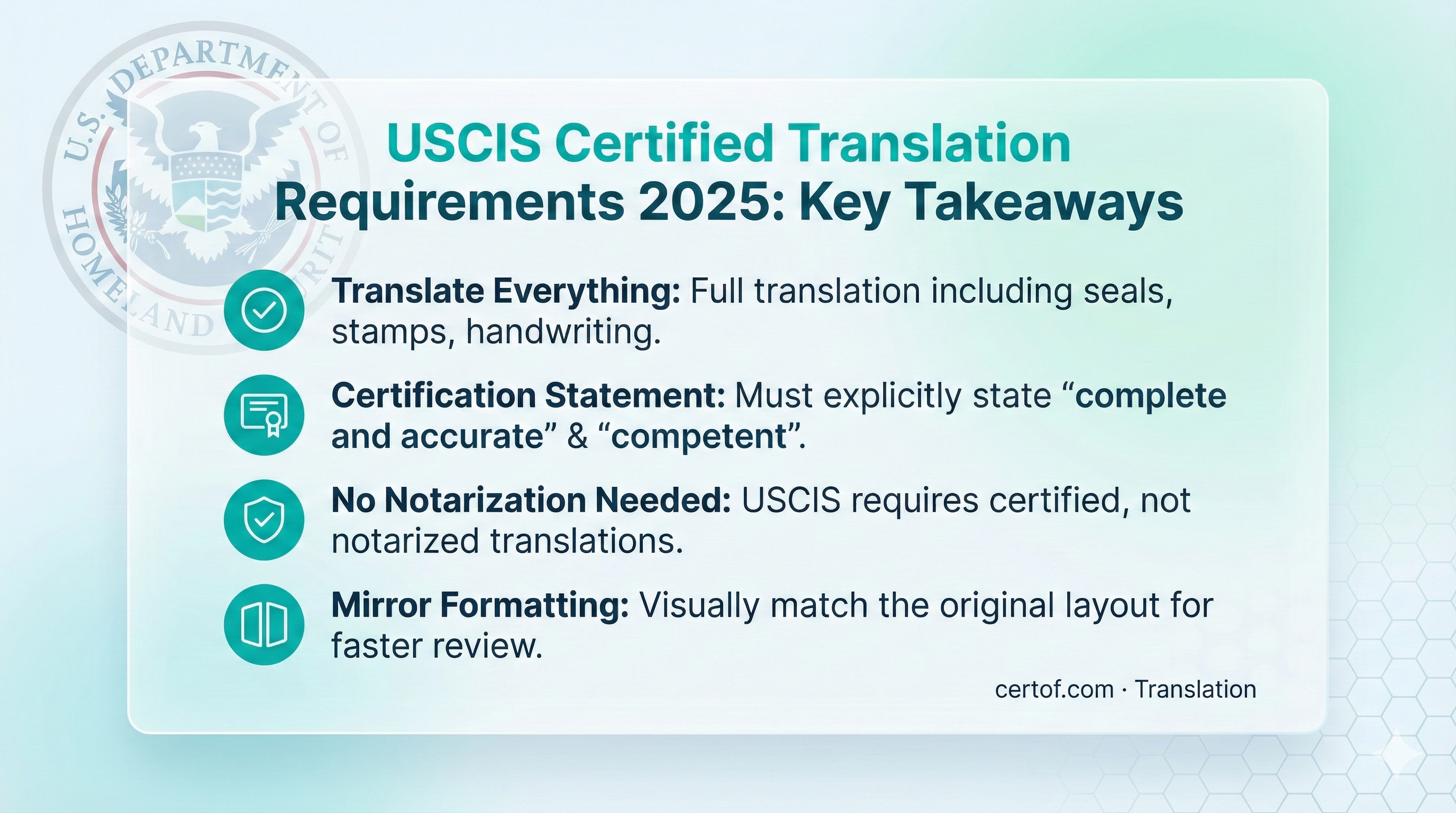
- Translation rule: every foreign-language document needs a full English translation and translator certification.
- Counterintuitive risk: unrequested originals may not be automatically returned and may be destroyed under records-retention rules.
- Best packaging habit: keep each source copy, translation, and certification page together as one exhibit.
Who This Guide Is For
This guide is for applicants in USCIS cases such as I-130, I-485, and N-400 who want to avoid three expensive mistakes: mailing irreplaceable originals too early, getting an RFE for incomplete translation, and paying twice to fix technical packaging errors.
What USCIS and Federal Rules Actually Require
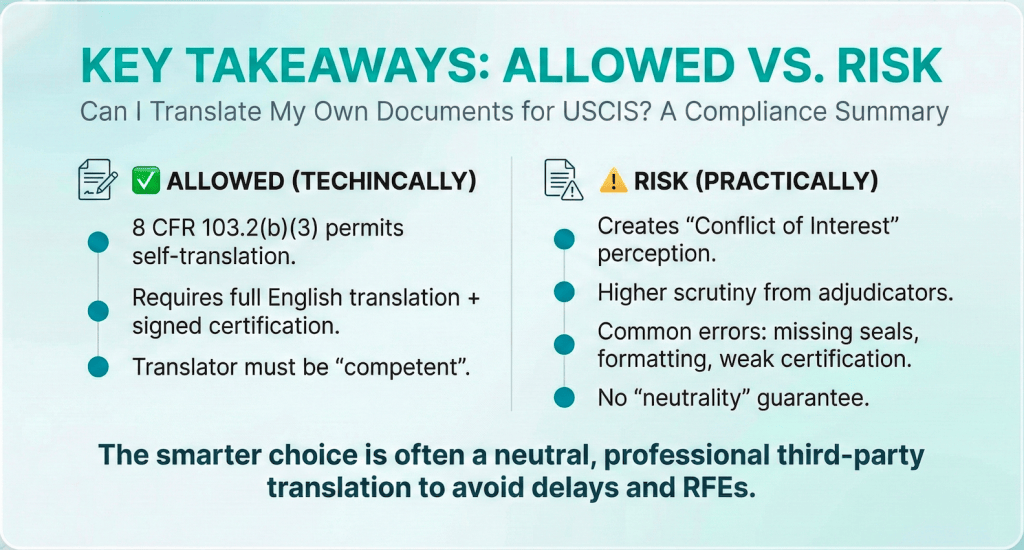
- 8 CFR 103.2(b)(3): a foreign-language document must include a full English translation certified as complete and accurate, with translator competence certification.
- 8 CFR 103.2(b)(4)-(5): USCIS allows originals or photocopies per form instructions and may request originals at any time.
- USCIS Tips for Filing Forms by Mail: submit legible copies, do not send originals unless required/requested, and understand unrequested originals are not automatically returned.
- USCIS Five Steps to File: repeat of copy-first guidance and translation certification requirements.
- Form pages for I-130, I-485, and N-400 should always be checked before filing.
The Counterintuitive Point Most Applicants Miss
Many people assume sending originals makes the case look stronger. For most initial USCIS mail-in packets, that instinct can increase risk. USCIS has repeatedly emphasized copy quality because many filings are scanned during intake. If an original is not required, keeping it in your own records is usually safer than mailing it early.
USCIS also published intake guidance on scanning efficiency in paper filings, which is why clean, legible, flat pages matter operationally: Recommendations for Paper Filings to Avoid Scanning Delays.
2026 Practice Detail: What Reviewers Catch Faster in Digital Workflows
These are filing best practices, not new statutes. In 2025-2026 workflows, better structure reduces avoidable RFEs because reviewers can map source text and translation faster.
- No-omission discipline: include visible seals, stamps, side notes, and back-page text in the translation when present.
- Clear mapping: one source document should map cleanly to one translation package.
- Document-level certification: best practice is one clear certification page per translated document exhibit.
- Layout-preserving formatting: mirror-style layout is not a legal requirement, but it improves readability during review.
Exact Packet Order That Reduces Translation RFEs
| Packet Item | What to Submit | Why It Matters |
|---|---|---|
| Foreign-language civil document | Legible copy of all pages/sides | Officer can verify each translated field against source |
| English translation | Full translation including visible stamps, seals, notes | Reduces incomplete-translation objections |
| Certification page | Signed statement of completeness, accuracy, and competence | Meets regulatory translation requirement |
| Exhibit labeling | Keep source + translation + certification together | Speeds review and lowers mismatch risk |
Common Mistakes and Real Consequences (Pitfalls)
- Sending originals when not required: loss of control over vital records and possible replacement delays.
- Partial translation: skipping a back-page stamp or handwritten note can trigger an RFE.
- Weak certification language: missing competence/accuracy wording can cause technical rejection issues.
- Self-translation without risk control: avoidable scrutiny and formatting mistakes. See can i translate my own documents for uscis and who can certify a translation for uscis.
- Poor scan quality: blurry or cut-off text slows adjudication and increases follow-up risk.
[Image Placeholder: Annotated document screenshot showing translated seal text, back-page note, and certification block + alt=”uscis certified translation completeness and mirror formatting checklist”]
CertOf vs Traditional Translation Routes
| Decision Factor | CertOf Online Workflow | Traditional Office Route |
|---|---|---|
| Turnaround | Typically 5-10 minutes for many standard files | Often 24-72 hours |
| Pricing clarity | Transparent certified translation pricing (as listed at time of writing) | Quote-based, rush fees common |
| Compliance packaging | USCIS-focused certified bundle with layout-preserving output | Varies by provider |
| Acceptance/refund terms | Published guarantee/refund policy terms | Often less explicit |
| Online convenience | Upload, pay, download | Email chains or office coordination |
[Image Placeholder: Statistical chart comparing turnaround and cost ranges by provider type + alt=”fast certified translation services comparison chart”]
3-Step Process: Get Certified Translation Without Mailing Originals First
- Start an online USCIS certified translation service order and upload clear scans/photos.
- Review names, dates, and document mapping; then complete payment.
- Download your certified PDF bundle and file copy-first; keep physical originals unless USCIS later requests them.
For service scope, visit official certified translation services by CertOf, review pricing details, or use the translation support contact page.
Trust and Compliance Notes
- Institution coverage commonly includes USCIS, universities, banks, and courts. For education-focused cases, see certified translation of academic transcripts. For legal-focused cases, see certified translation of divorce decree to English.
- For privacy terms, review the public privacy policy.
- If USCIS issues a translation RFE, follow a structured fix path with USCIS RFE translation services guidance.
- If your filing also involves UK or Canada, see certified translation for UKVI and certified translation for IRCC Canada.
FAQ (People Also Ask)
Do I need to send original documents with certified translation to USCIS?
Usually no for initial filing. Use legible copies and a compliant certified translation, unless form instructions or a USCIS notice explicitly asks for originals.
Can I submit scanned copy of certified translation for USCIS?
In most filings, a clear scanned/printed package is standard. Use this USCIS certified translation sample and template and this USCIS certified translation requirements checklist before mailing.
Does USCIS accept digital certified translations?
USCIS focuses on completeness, legibility, and proper certification. Many applicants use digital-to-print workflows successfully, but always follow your current form instructions and filing channel requirements.
Do I need notarization or a wet seal for USCIS translation?
For USCIS, certified translation is the core requirement; notarization is usually not the default requirement. See certified vs notarized translation.
What if USCIS asks for the original document later?
Send exactly what the notice requests, by the deadline and to the address in the notice. If needed, review Request for the Return of Original Documents (Form G-884), plus CertOf guides on how to fix a rejected USCIS translation, how to reuse certified translations across USCIS cases, and how long a certified translation is valid for USCIS.
Final Action Checklist
- Confirm your current form instructions first, especially for I-130/I-485/N-400 evidence handling.
- Use copy-first for initial filing unless originals are explicitly required.
- Include full translation and a proper certification page for each foreign-language exhibit.
- Keep originals in an interview-ready folder and respond quickly if USCIS requests them later.
Start your online certified translation now | Check transparent pricing | Review guarantee and refund terms