Disclaimer: This article provides general information about USCIS translation requirements and professional best practices. It does not constitute legal advice. If your case involves complex legal issues, consult a qualified immigration attorney.
About the author: Erin Chen is the Co-Founder and Translation Strategist at CertOf™. With over a decade in bilingual editorial risk control and hands-on experience navigating the U.S. immigration process, Erin helps applicants prepare USCIS-ready certified translations that reduce avoidable delays.
If your case depends on income proof, an income tax return certified translation is not just language work. It is evidence engineering. In most delays we review, the issue is not English quality. It is missing schedules, mismatched names, or a weak certification statement.
Income Tax Return Certified Translation: Fast Compliance Without Costly Rework
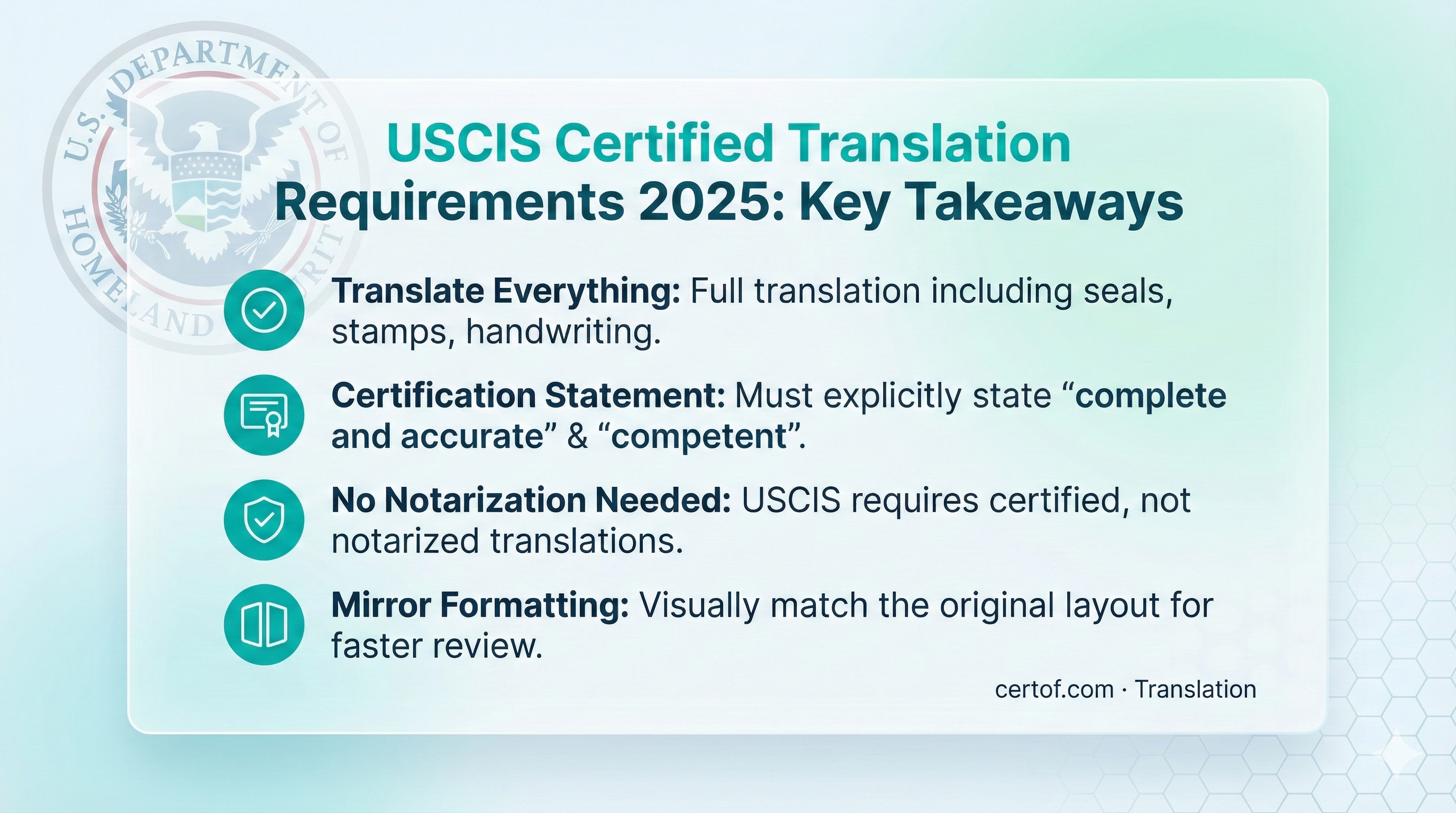
- USCIS requires a full English translation of any foreign-language document plus translator certification of completeness and accuracy under 8 CFR 103.2(b)(3).
- Financial-support filings commonly rely on tax and income evidence, including I-864 workflows: USCIS Form I-864.
- UK visa applications require complete translation details, including translator identity and contact information: UKVI supporting documents guidance.
- Mortgage underwriting with foreign income requires translated records that are complete and traceable: Fannie Mae Selling Guide B3-3.1-09.
Target Users for Income Tax Return Certified Translation
- Immigration applicants preparing I-864 or related financial packets.
- Visa applicants submitting tax returns, salary slips, or sponsor income documents.
- Borrowers handling foreign tax return translation for loan underwriting.
- Applicants who need payslip certified translation for renting, study, or family sponsorship files.
To avoid repeating basics already covered in detail, this article focuses on tax return and payslip specifics. For general USCIS translation rules, use USCIS certified translation requirements.
What Must Be Translated in Tax Returns and Payslips
| Document | Translate in full | Frequent misses that trigger rework |
|---|---|---|
| Income tax return | Tax year, filing status, identity fields, income tables, schedules used as proof, authority notes, stamps | Only page 1 translated, schedule pages omitted, stamp text ignored |
| Payslip / pay stub | Employer legal name, pay period, gross pay, deductions, net pay, YTD totals, currency labels | Deduction categories collapsed into one label, date window unclear |
| Employer letter | Position, salary basis, employment status, start date, signatory block | Salary translated but status language omitted |
| Bank statement used for support | Holder name, statement period, running balance lines, salary entries where relevant | Summary translation instead of line-complete translation when requested |
Payslip Certified Translation: What Lenders and Officers Check First
- Gross vs net clarity: reviewers compare gross income, deduction logic, and net pay consistency with the application form.
- Period alignment: monthly payslips must align with the tax year and filing period claimed elsewhere.
- Employer identity: legal entity name and branch details must remain faithful to source documents.
- Currency fidelity: keep original currency labels and symbols; do not silently convert values in the translation body.
If your case also includes education-based financial review, this companion guide can help: certified translation of academic transcripts for WES/ECE/SpanTran.
Counter-Intuitive Risk: Translating More Pages Can Hurt Your Case
Many applicants think more pages always means safer filing. In practice, over-translation can introduce unnecessary mismatch risk. If your checklist asks for specific income schedules, adding unrelated pages may create conflicting totals and extra questions.
The safer strategy is not maximum volume. It is exact-scope, full-fidelity translation of the pages your checklist actually requires. For checklist-first filing logic, see do I need original document with certified translation for USCIS and reuse certified translation in multiple USCIS cases.
Common Pitfalls and Their Real Consequences
1. Summary-only translation
Only headers and totals are translated while schedule lines are skipped. Consequence: document may be treated as incomplete, triggering an RFE, lender condition, or checklist return.
2. Name inconsistency
Passport name and translated payslip name do not match exactly. Consequence: identity clarification requests and avoidable delay.
3. Missing certification statement
A readable translation without a proper translator declaration can be treated as non-compliant in formal review.
4. Currency rewriting
Values are silently converted or normalized by the translator. Consequence: reviewers cannot map translated numbers to source records.
5. Machine-only output
No accountable human certification and missed stamp text create a high rejection risk in regulated workflows.
If you are already fixing a case, use USCIS RFE translation services.
CertOf vs Traditional Agency Workflow
| Criteria | CertOf workflow | Traditional offline workflow |
|---|---|---|
| Turnaround | Digital-first process, often 5-10 minutes for standard files | Commonly 24-72 hours |
| Pricing model | Published from $9.99/page, transparent checkout | Quote-by-quote, frequent add-on fees |
| Formatting | Mirror formatting to preserve original layout | Layout preservation often extra or manual |
| Acceptance support | Published USCIS-focused policy terms and refund documentation | Varies by vendor |
| Ordering | Fully online upload-pay-download | Email threads and manual coordination |
You can start at order certified translation online, review the current terms at USCIS acceptance guarantee and refund policy, or speak with a specialist via talk to a certified translation specialist.
3-Step Submission Workflow
- Upload: send tax returns and payslips via secure document upload for certified translation.
- Confirm: verify page count, timing, and output format before checkout.
- Download and submit: receive your certified package and file with USCIS, UKVI, lender, school, or court.
Data Privacy and Document Handling
Financial files are sensitive. Before uploading, review the platform privacy terms directly: CertOf privacy policy. For legal terms and service boundaries, see terms of service.
Need Deeper Detail on Related Topics?
- difference between certified and notarized translation
- who can certify a translation for USCIS
- what a USCIS certified translation sample looks like
- can I use Google Translate for USCIS
- fast certified translation benchmarks by document type
FAQ
Does USCIS accept online certified translations for tax returns and payslips?
USCIS focuses on completeness and certification quality, not whether the process started online. Use USCIS certified translation requirements as your baseline checklist.
Do I need notarization for income document translation?
Usually, no. Many cases require certified translation, not notarization, unless your receiving institution explicitly asks for notarization. See certified vs notarized translation.
Do I need original documents with certified translation?
Often, copies or scans are accepted at submission stage, while originals may be requested later by procedure. See original document vs copy guidance for USCIS.
Can I reuse one tax-return translation in another filing?
Often yes, if the source document is unchanged and still relevant to the new filing year and checklist. See reuse checklist for certified translations.
How long is a certified translation valid for USCIS?
USCIS does not assign one universal expiration date for all certified translations, but practical validity depends on document relevance and whether the underlying source has changed. See how long a certified translation is valid for USCIS.
What should I do if translation issues already triggered an RFE?
Fix scope first, then certification wording, then packaging order. Follow USCIS RFE translation response steps.
Final CTA
If your deadline is close, do not wait until filing day. A complete, reviewer-friendly income tax return certified translation package can prevent weeks of avoidable delay.
Upload your tax return and payslips for certified translation now.