Disclaimer: This article provides general information about USCIS translation requirements and professional best practices. It does not constitute legal advice. If your case involves complex legal issues, consult a qualified immigration attorney.
About the author: Erin Chen is the Co-Founder and Translation Strategist at CertOf™. With over a decade in bilingual editorial risk control and hands-on experience navigating the U.S. immigration process, Erin helps applicants prepare USCIS-ready certified translations that reduce avoidable delays.
K-1 Fiancé Visa Packet Translation: Fast Compliance, Fewer RFEs, and No Unnecessary Re-Translation
If you are preparing a K-1 case, this k-1 fiancé visa packet translation guide gives you a stage-based plan: what to translate for USCIS now, what to prepare for the consular interview later, and what can usually be reused for adjustment of status after entry. The goal is to reduce avoidable delays, avoid duplicate costs, and submit a packet officers can review quickly.
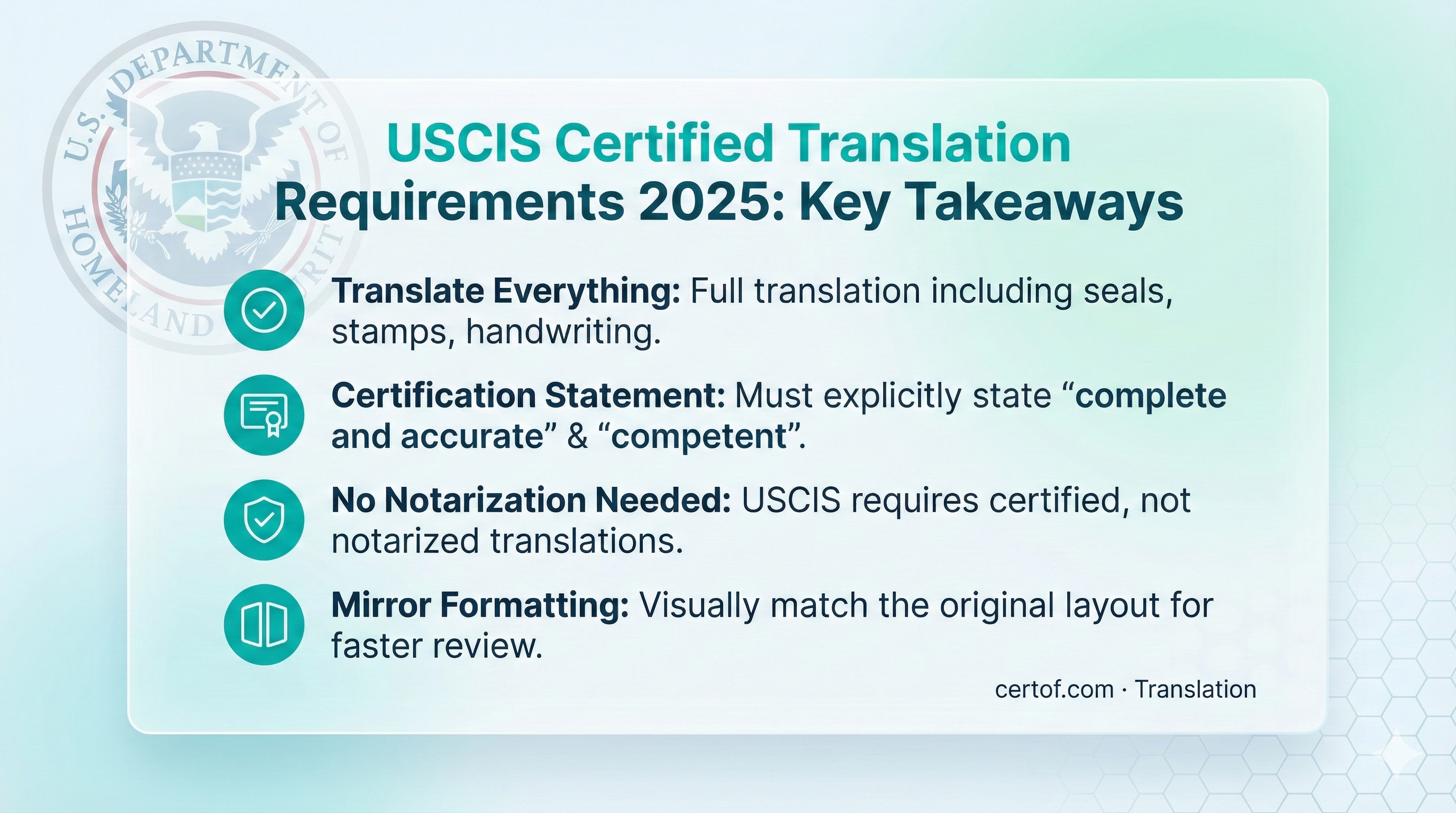
- USCIS requires full English translation plus translator certification for foreign-language documents you submit.
- Consular processing follows post-specific instructions, so timing and document versions matter.
- Certification and notarization are different. USCIS usually focuses on proper certification language.
- A staged workflow is often cheaper and safer than translating everything on day one.
Start your K-1 certified translation order online if your filing timeline is tight.
Quick Navigation
- Official rules and sources
- Counterintuitive timing strategy
- Stage-by-stage checklist
- Common pitfalls
- 3-step workflow
- FAQ
Who This Guide Is For
- U.S. citizen petitioners and foreign fiancé(e)s handling I-129F without a full legal operations team.
- Couples worried about translation-related RFEs, interview delays, or 221(g)-style follow-up.
- Applicants who need fast certified document translation services online with predictable pricing.
- Families who want one clean document system they can reuse at later stages.
Official Rules to Rely On
If you want full USCIS fundamentals, CertOf already has deep guides. This page stays focused on K-1 stage strategy and document timing.
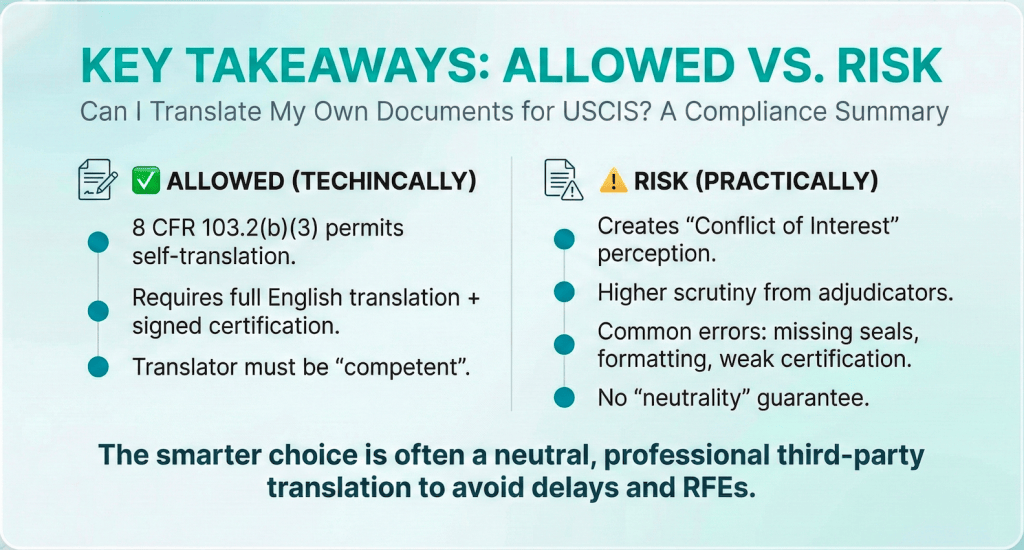
- 8 CFR 103.2(b)(3): foreign-language documents submitted to USCIS must include full English translation and translator certification of accuracy and competence.
- USCIS Form I-129F page: petition context and filing pathway.
- USCIS fiancé(e) process page: USCIS stage overview and process handoff.
- U.S. Department of State K-1 page: interview-stage requirements, required documents, and post-level notes.
- DS-160: online nonimmigrant visa application required for K visa processing.
- post-specific instructions: embassy/consulate K-1 post details.
- U.S. Department of State Visa Reciprocity and Civil Documents by Country: country-level civil document standards.
- DOS Civil Documents FAQ: document upload formatting guidance used in practice by many applicants.
For USCIS detail pages already published on CertOf, see USCIS certified translation requirements and USCIS certified translation sample.
Related Questions and Deep Guides
- i-129f certified translation requirements
- certified translation for consular interview
- medical vaccination record translation for k1 visa
- can I use Google Translate for USCIS
- do I need original document with certified translation USCIS
- how long is a certified translation valid for USCIS
Counterintuitive Insight: Translating Everything at the Start Can Increase Risk
Most couples think early bulk translation is always safer. In real K-1 workflows, it often creates rework. Document sets can change by stage, and some records are time-sensitive or replaced with newer issuances before interview.
One practical detail many applicants miss: if your post or NVC workflow requires CEAC uploads, it is usually cleaner to upload the source page and translation together in one combined file, with the native-language page first and the English translation next. Splitting them can make officer review slower.
For USCIS-side reuse strategy and validity logic, see how to reuse one certified translation across multiple USCIS stages and how long certified translations stay usable.
Stage-by-Stage K-1 Translation Checklist
| Stage | Typical document set | Translation standard | Best timing | If done poorly |
|---|---|---|---|---|
| I-129F petition (USCIS) | Any non-English evidence you submit, including civil-status and relationship-support records | Full translation plus signed certification of completeness/accuracy and translator competence | Translate only what goes into the petition packet now | RFE for missing, partial, or weakly certified translation |
| Consular interview prep | Birth certificate, prior-marriage termination records, police certificates, and interview-specific civil documents | Certified translation aligned to final interview document versions and post instructions | Translate after post instructions and document versions are confirmed | Interview delay, additional document request, and extra translation cost |
| After entry: AOS (I-485) | Non-English civil documents reused or newly added for adjustment | Reuse often possible if source document is unchanged and packet stays complete | Maintain one clean digital master packet with version labels | Duplicate payment and avoidable filing friction |
Deep-Dive Note: Chinese Notarial Certificates and Bilingual Civil Records
This is where many K-1 packets become inconsistent. If your case uses Chinese notarial certificates, household register pages, or mixed-script names, lock one transliteration standard and use it across all documents (I-129F, DS-160, civil records, and certified translations). Small name-order differences can trigger avoidable questions.
- Translate seals, issuing authority names, and annotation text, not only main body fields.
- If source pages are multi-column or table-heavy, preserve structure for side-by-side officer comparison.
- Keep one naming map for personal names and place names to avoid cross-document mismatch.
- For medical timing issues, use the dedicated guide for certified translation of medical records to English and the K-1-adjacent guide for vaccination card translation for immigration.
Common Mistakes and Their Real Cost
- Partial translation: stamp text, back-side serial notes, or handwritten marginal text omitted. Result: incompleteness concerns and follow-up requests.
- One blanket certificate for unrelated documents: weaker traceability and higher review friction.
- Self-translation without risk control: not categorically prohibited in every context, but it can increase scrutiny in practice.
- Confusing notarization with certification: paying extra for a notary does not fix a non-compliant certification statement.
- Version mismatch: old translation attached to updated civil record causes rework near interview deadlines.
If you are already under pressure, use USCIS RFE translation response checklist and how to fix a rejected USCIS translation packet.
CertOf vs Traditional Path for K-1 Translation Packets
| Decision factor | CertOf online workflow | Traditional local agency / law-office add-on |
|---|---|---|
| Speed | Typically 5-10 minutes for standard files | Commonly 24-72+ hours |
| Pricing | From $9.99/page with public pricing details | Often quote-based, with rush surcharges |
| Compliance packaging | Certificate of Translation Accuracy, online verification, policy visibility | Varies widely by provider |
| Format quality | Mirror formatting / layout-preserved output for easier review | Often plain text output |
| Acceptance and refund policy | See current refund/cancellation terms before purchase | Usually no standardized policy language |
3-Step Workflow to Get Your Certified Translation Online
- Start your K-1 certified translation order online.
- Check USCIS-focused certified translation pricing.
- Review current refund and returns policy before checkout.
If your interview date is close, request urgent certified translation support for K-1 timelines.
Trust Module: Privacy, Security, and Institution Coverage
- CertOf publishes legal terms and privacy controls on policy pages for document-handling transparency.
- Typical receiving institutions include USCIS, universities, banks, courts, and other official reviewers.
- Before final submission, always confirm recipient-specific formatting and signature expectations.
Policy links: Privacy Policy | Terms of Service.
FAQ
Do I need certified translation for I-129F evidence?
If you submit foreign-language evidence to USCIS, you generally need full English translation plus compliant certification. See USCIS certified translation requirements.
Can I translate my own documents for a K-1 case?
It is not categorically prohibited in every scenario, but self-translation can raise neutrality and completeness concerns in high-stakes filings. See self-translation risk guide.
Do I need notarized translation for USCIS?
For USCIS filings, certification language is usually the core requirement. Notarization is a separate concept and context-dependent. See certified vs notarized translation.
Can I reuse the same translation for I-485 after entering on K-1?
Often yes, if the underlying document has not changed and your packet remains complete. Use the USCIS reuse checklist and review AOS (I-485) filing context.
Can I use Google Translate for USCIS submissions?
Machine output can help drafting, but USCIS submissions need accountable, complete, certified translation quality. See Can I Use Google Translate for USCIS?.
After marriage, can I use the same provider for DMV/insurance document translation?
Yes, many applicants keep one workflow for post-entry paperwork. See driver license translation for DMV and insurance.
Final Pre-Submission Checklist
- Main stage identified: USCIS filing, interview prep, or post-entry AOS.
- Every visible text element translated: seals, stamps, side notes, and reverse-page text where present.
- Source plus translation plus certification packaged together in review-friendly order.
- Name spelling and date formats are consistent across forms and translations.
- Digital master copy saved for reuse in later USCIS or institution workflows.
Start your k-1 fiancé visa packet translation now and move from document stress to a clean, interview-ready packet.