Disclaimer: This article provides general information about USCIS translation requirements and professional best practices. It does not constitute legal advice. If your case involves complex legal issues, consult a qualified immigration attorney.
About the author: Erin Chen is the Co-Founder and Translation Strategist at CertOf™. With over a decade in bilingual editorial risk control and hands-on experience navigating the U.S. immigration process, Erin helps applicants prepare USCIS-ready certified translations that reduce avoidable delays.
Korean Family Relation Certificate Translation: Fast, Compliant, and Built to Avoid Rework
If you need a korean family relation certificate translation, the biggest risk is usually not language quality. It is document selection: wrong version, incomplete fields, or outdated issuance date at consular stage. This guide gives you a practical path to file faster, stay compliant, and avoid expensive re-submissions.
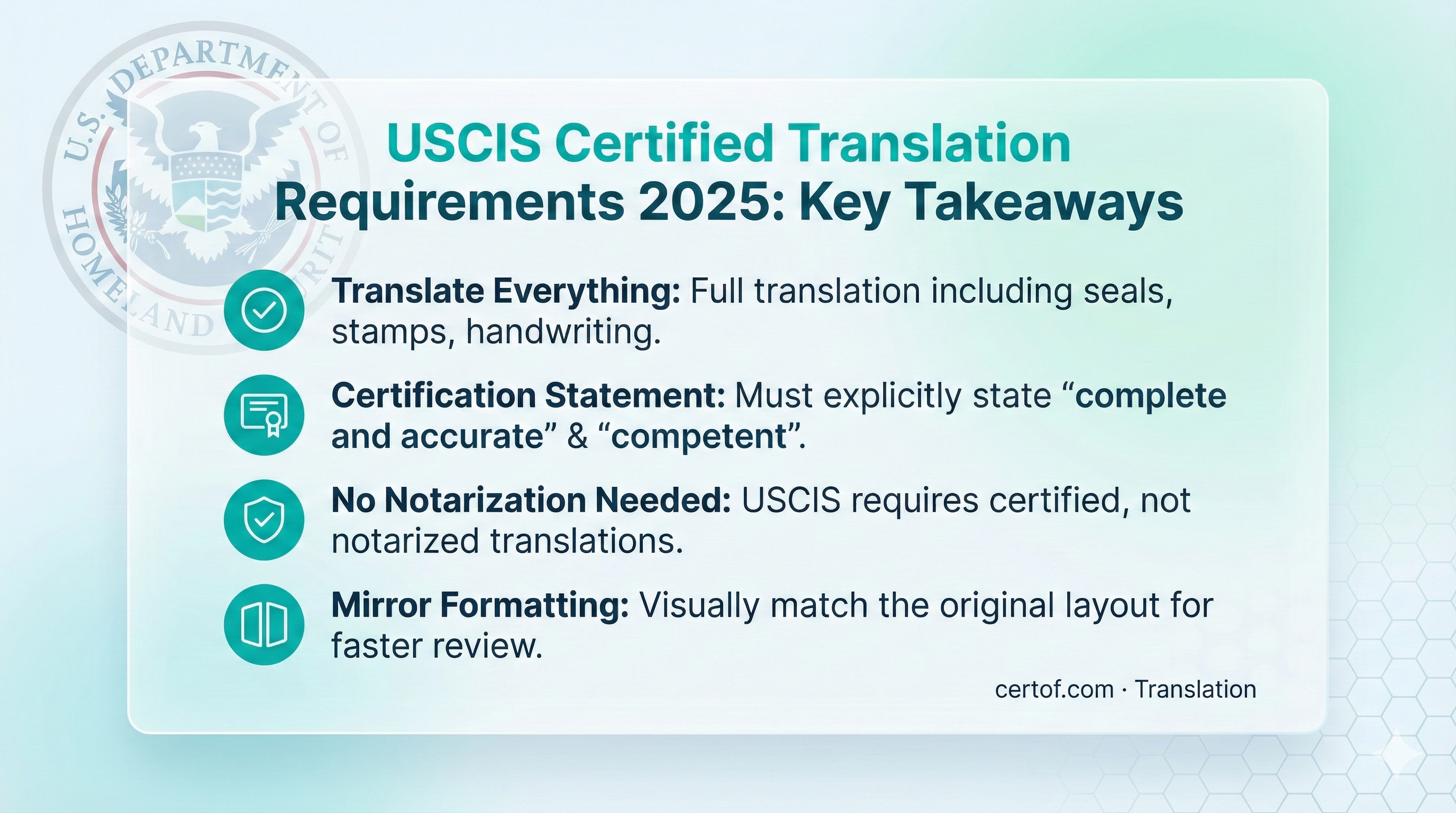
- USCIS baseline: full English translation plus a proper signed certification statement.
- Seoul 2026 update: for immigrant visa processing, do not use the government-issued English Family Relations certificate as your core record.
- For Korean civil records at Seoul post, Detailed versions and 1-year issuance freshness are key review points.
- Execution shortcut: mirror-formatted certified translation, clean exhibit packaging, and a 3-step order workflow.
If you need the general framework first, read our USCIS certified translation requirements guide and USCIS certified translation sample. This page focuses on Korea-specific traps.
Who This Guide Is For and What Hurts Most
I wrote this for Korean nationals, U.S. petitioners filing I-130, applicants filing I-485, and families preparing NVC immigrant visa document uploads. Most readers are dealing with the same pressure: strict timelines, multiple family records, and fear of a checklist or RFE caused by one small document mismatch.
- Target reader: family-based immigration applicants and petitioners in active filing windows.
- Main pain point: I have a certificate, but I am not sure this exact version is acceptable.
- Main cost of mistakes: interview delay, re-translation fees, and months of avoidable waiting.
2026 Update: Why Seoul Post Rejects the English Family Relation Certificate
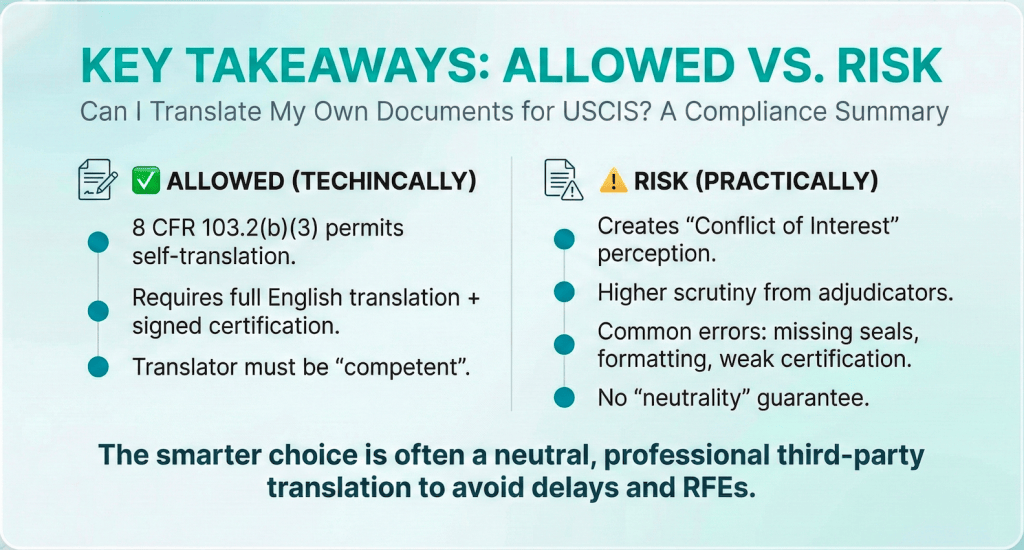
For USCIS filings, the core translation rule comes from 8 CFR 103.2(b)(3): any non-English record needs a full English translation with a signed certification of completeness, accuracy, and translator competence.
USCIS filing logistics are covered in Tips for Filing Forms by Mail. For immigrant visa processing, the Department of State framework is here: NVC Step 7 Civil Documents.
Now the Korea-specific update: the U.S. Embassy Seoul supplement page (last updated January 2, 2026) states, You must not submit an English version of Family Relation Certificate. It also instructs Korean applicants to use Detailed records with English translation and highlights 1-year issuance freshness for key civil certificates in the pre-interview checklist. Source: U.S. Embassy Seoul Supplement.
Scope note: this rule applies to immigrant visa processing at Seoul post. Do not automatically apply every post-specific checklist item to every USCIS form context.
Which Korean Records to Translate (and When)
| Evidence Goal | Korean Document to Prepare | Seoul Immigrant Visa Timing Signal | Translation Scope |
|---|---|---|---|
| Birth and parentage context | Basic Certificate (Detailed, 상세) + Family Relations Certificate (Detailed, 상세) | Issued within one year at Seoul pre-interview checklist stage | Translate all fields, stamps, issue data, and notes |
| Marriage history | Marriage Relations Certificate (Detailed, 상세) | Issued within one year for Korean nationals in Seoul checklist logic | Include prior marriage/divorce history fields when present |
| Older registry history (pre-2008 scenarios) | Jejeok Deungbon (Family Census Register), where applicable | Use as alternate evidence when current certificates are not available | Translate historical entries and registry annotations fully |
| Convenience English certificate option | Do not rely on this alone for immigrant visa processing | May trigger checklist deficiency | Use Korean Detailed source + certified English translation |
The Counterintuitive Point Most Applicants Miss
The government-issued English Family Relations certificate feels like the safest shortcut. In reality, for immigrant visa use, it can be weaker than the Korean original plus certified translation. The reciprocity page explains why: the English certificate is treated as a different certificate type and may lack children information needed for immigrant visa review. Source: South Korea Reciprocity and Civil Documents.
That is why “already in English” does not automatically mean adjudication-ready. For this document family, detail depth matters more than language convenience.
Pitfalls That Trigger RFE or Checklist Delays
- Submitting General (Ilban) instead of Detailed (Sang Sae): relationship history appears incomplete, which may trigger checklist deficiency or RFE.
- Using only the English Family Relations certificate: higher risk at immigrant visa stage because core family-detail fields may be missing.
- Using stale source documents for Seoul interview prep: if issuance freshness does not match post instructions, you may be asked to re-obtain documents.
- Partial translation only: missing seals, back-page text, or marginal notes can make the package non-compliant under USCIS standards.
- Name romanization inconsistency across exhibits: one spelling drift can create identity-friction review and downstream delay.
CertOf vs Traditional Agencies: Practical Decision Table
| Decision Factor | CertOf Digital Workflow | Typical Offline Agency Path |
|---|---|---|
| Speed | Many standard pages delivered in about 5-10 minutes | Commonly 24-48 hours or longer |
| Price Transparency | Starting from $9.99/page, visible before checkout | Often quote-based with variable rush surcharges |
| Compliance Packaging | USCIS-style certification and mirror formatting for easier review | Format and certification consistency varies by vendor |
| Risk Handling | Published 100% USCIS acceptance guarantee policy with revision/refund terms | Usually limited revision-only terms |
| Ordering Experience | Upload, pay, download online | Email chains, office visits, or manual pickup |
How to Complete the Translation in 3 Steps
- Upload clear scans of your Korean Detailed certificates and order certified translation online for immigration documents.
- Confirm scope and timing, then keep your package aligned with USCIS certification wording standards.
- Download the certified set and store a digital master for future filings; see our reuse strategy for multiple USCIS cases.
Commercial support links: certified translation services for USCIS and visa cases | urgent certified translation support for deadline cases | certified translation refund and guarantee policy.
Privacy, Security, and Institution Coverage
For identity-heavy files, use secure upload channels and controlled access workflows. A professional process should keep source file, translated file, and certification statement traceable as one exhibit unit.
Typical receiving institutions include USCIS, NVC/consular posts, universities, banks, and courts. If your case is urgent, ask for expedited handling before checkout so the timeline is explicit from the start.
FAQ (People Also Ask)
Does USCIS accept online certified translations?
USCIS evaluates whether the translation and certification meet legal standards, not whether you ordered online or in person. Start with this checklist: USCIS certified translation requirements.
Do I need original documents with certified translation for USCIS?
For many initial filings, copy-first packaging is common, while originals are retained unless specifically requested. Practical guide: do I need original document with certified translation.
Is the English Family Relation Certificate from Korea accepted for I-130?
For USCIS petition filing, officers assess evidence sufficiency under USCIS standards. For immigrant visa processing at Seoul post, the supplement explicitly tells applicants not to submit the English Family Relations certificate as the core civil record. Use Korean Detailed documents plus certified translation for the safest cross-stage strategy.
Can I translate my own Korean family documents for USCIS?
Self-translation can create avoidable credibility and consistency risk in high-stakes cases. Risk breakdown: can I translate my own documents for USCIS.
What is the difference between certified and notarized translation?
For most USCIS use cases, certified translation is the baseline requirement; notarization is a separate layer used only when specifically requested by another authority. See: certified vs notarized translation guide.
How long is a Korean certificate translation valid?
The translation may remain usable if accurate and complete, but Seoul immigrant visa workflows can still require newly issued Korean source records. Read: how long certified translation is valid for USCIS.
Final Submission Checklist
- You selected Korean Detailed (Sang Sae) records, not General versions.
- Your source documents match current stage rules (USCIS vs Seoul consular workflow).
- All visible content is translated, including stamps, side notes, and issue metadata.
- The signed certification statement is included in the same exhibit package.
- You saved a reusable digital master copy for future filing steps.
Start your korean family relation certificate translation now | Talk to a certified translation specialist today