Disclaimer: This article provides general information about USCIS translation requirements and professional best practices. It does not constitute legal advice. If your case involves complex legal issues, consult a qualified immigration attorney.
About the author: Erin Chen is the Co-Founder and Translation Strategist at CertOf™. With over a decade in bilingual editorial risk control and hands-on experience navigating the U.S. immigration process, Erin helps applicants prepare USCIS-ready certified translations that reduce avoidable delays.
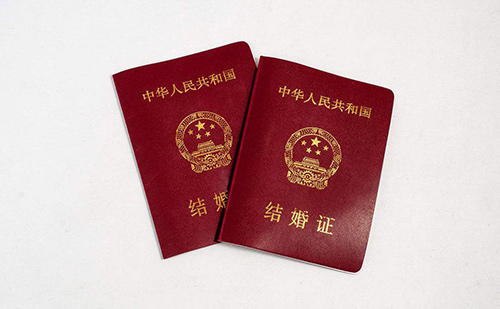
Coverage of marriage certificate in Chinese
If you’re filing a marriage-based USCIS case, your marriage certificate is not “just another attachment.” It is the legal bridge that connects names, dates, places, and marital history across your packet. That’s why marriage certificate translation for USCIS is one of the most common places applicants accidentally create avoidable friction.
Key takeaways (read this first)
- The rule is stable: USCIS still expects a complete English translation plus a signed translator certification for any foreign-language document.
- Marriage certificates have “identity logic”: registry numbers, marginal notes, and stamps often explain how the record was created or amended.
- Counterintuitive but critical: do not “fix” typos or inconsistencies inside the translation. Translate what the document says, then explain conflicts separately if needed.
- K-1 nuance: if you marry in the U.S., your marriage certificate is usually already in English. The translation risk often shifts to prior civil records (foreign divorce decrees, name change documents, prior marriage records), not the U.S. certificate itself.
What USCIS actually requires (quick version)
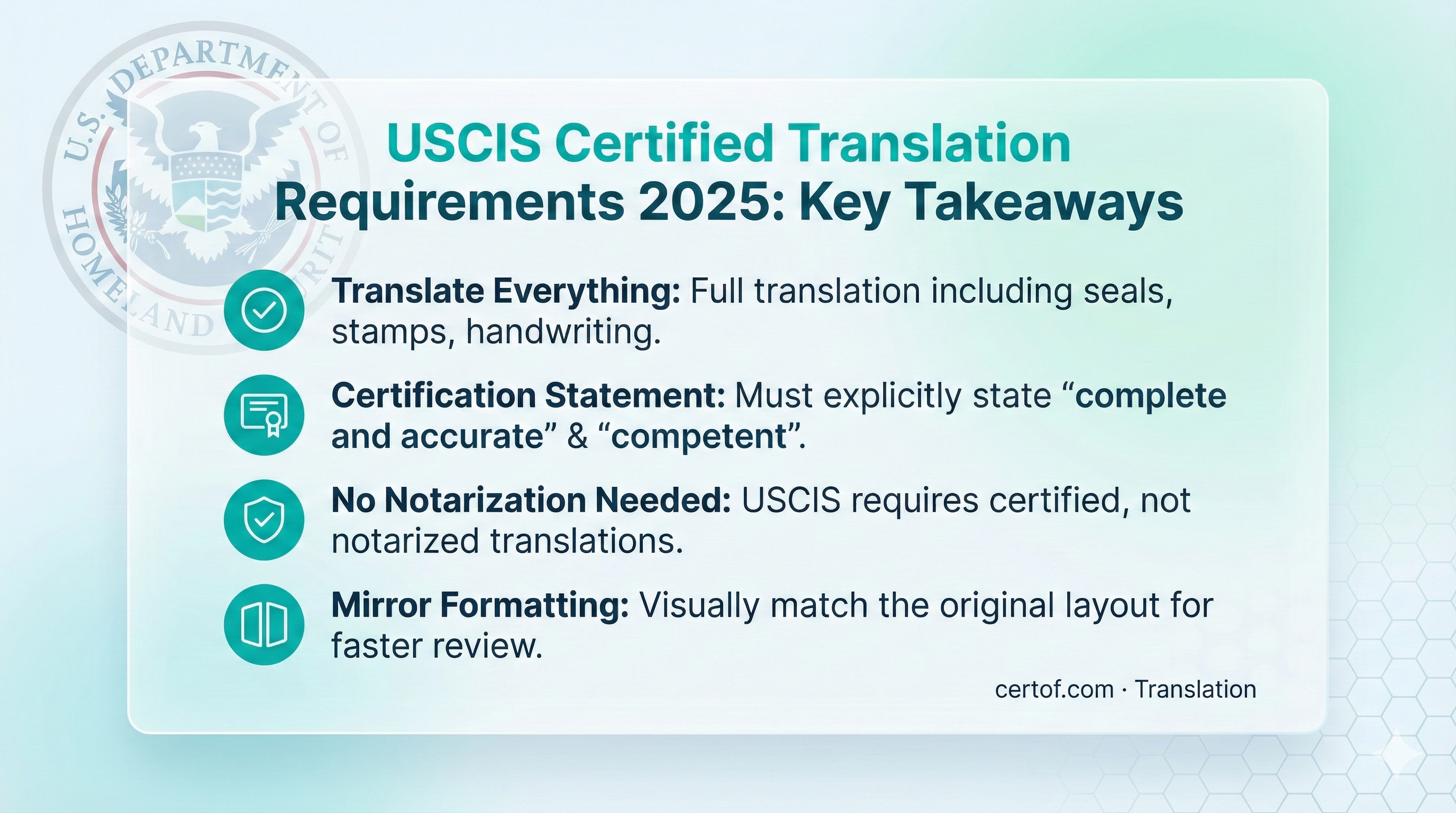
USCIS requirements for translations are grounded in a federal regulation. In plain English, the agency expects:
- a full English translation of the foreign-language document, and
- a signed certification stating the translation is complete and accurate and the translator is competent to translate into English.
This article stays marriage-certificate-specific. For the full breakdown of the rule, a modern certification template, and broader “mirror formatting” guidance, see our detailed guide: USCIS Certified Translation Requirements. For a visual example of what “USCIS-ready formatting” looks like, see: USCIS Certified Translation Sample.
Why marriage certificates get extra scrutiny in I-130 / I-485 review
In a marriage-based filing, officers are not only checking whether a document exists; they are checking whether the record fits the timeline and identity story your forms tell. A marriage certificate often links:
- your names (including maiden names and transliterations),
- dates and places of birth,
- the marriage date and location,
- registration numbers or ledger references, and
- administrative notes that may reference prior marital status or later amendments.
In practice, relationship-based filings can feel “high scrutiny” because small inconsistencies are easy to flag and hard to ignore. The goal is not to make your translation look impressive; it’s to make it low-risk to verify.
Marriage certificate translation checklist (what USCIS requires)
Applicants often assume only the names and marriage date matter. For USCIS, that’s an incomplete approach. A strong marriage certificate translation typically covers all visible text and also makes it easy to map the English back to the original.
| Area on the certificate | What to include in the translation | Common real-world miss |
|---|---|---|
| Issuing authority | Full name of the civil registry/office, plus any district/city identifiers | Leaving logos/headers untranslated because they “look decorative” |
| Record identifiers | Registration number, book/volume/page, certificate number, QR code label text | Dropping registry numbers that help authenticate the record |
| Names | Exact spelling as shown, including diacritics where present; clarify name order when needed | Quietly “standardizing” names to match passports without noting what the document actually says |
| Dates and locations | Marriage date, place of registration, place of marriage (if different), DOB fields (if present) | Converting calendars or formats without preserving the original meaning |
| Marital status references | Any lines that reference prior divorce/widowhood status or legal basis for registration | Skipping small-print notes that explain eligibility |
| Stamps, seals, signatures | Translate text in stamps/seals when legible; otherwise note presence (e.g., “[Round seal present]”) | Ignoring faint stamps or back-page markings |
| Marginal notes / amendments | Translate handwritten notes, corrections, or re-issuance notes | Missing side notes that change the legal interpretation of the record |
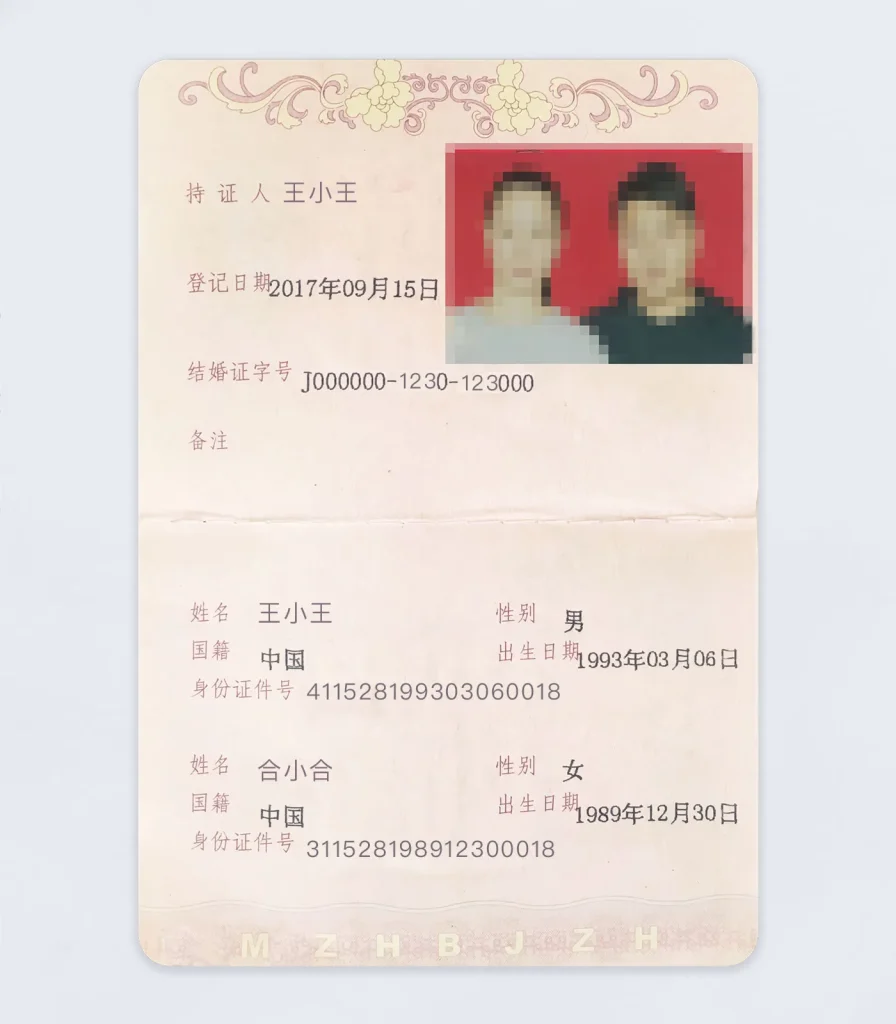
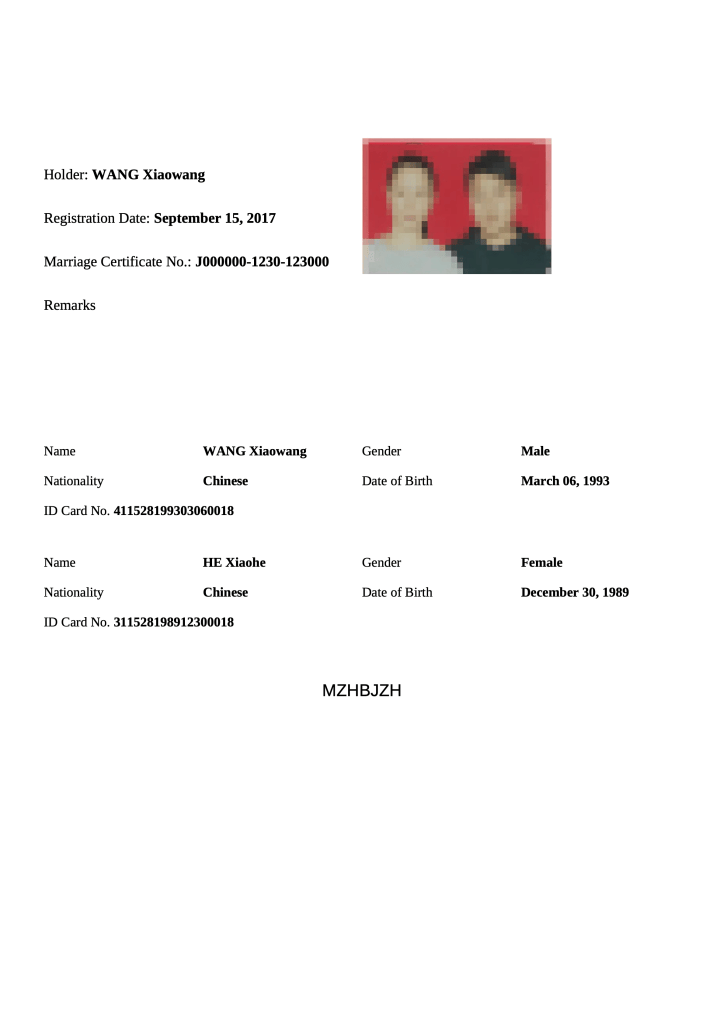
Mirror translation sample of Marriage Certificate from Chinese into English – Page 1
The “extract vs long-form” trap (and how to handle it)
Some countries issue multiple versions of a marriage record:
- a short extract (minimal fields),
- a long-form civil record (more identifiers and notes), or
- a ceremonial certificate that is not the civil registry record.
USCIS generally cares that the document is a valid civil record and that it is fully translated and properly certified. If you have multiple versions, translate the one that best shows official identifiers (registry numbers, office names, stamps). If you are unsure which version is the “civil” one, many applicants choose to translate the most official-looking registry record and include the other as supplemental evidence.
Counterintuitive but essential: do not “fix” typos inside the translation
This is one of the fastest ways to create credibility problems.
If the original marriage certificate contains an error (for example, a digit in a birth year, a misspelled place name, or inconsistent romanization), the translation should reflect the document as written. If you silently correct it inside the translation, you risk creating a mismatch between the foreign-language original and the English version.
A safer approach:
- translate the text as-is,
- optionally add a neutral translator note such as “(as written on the original)” when appropriate, and
- address the discrepancy in a separate cover letter, affidavit, or additional evidence if needed.
Packaging checklist: how to submit the marriage certificate translation cleanly
Whether you file by mail or upload to myUSCIS, your goal is the same: make the relationship between the original record and the English translation unambiguous.
- Use a clear scan: include the full page, corners visible, no cut-off seals, and include the back page if it has stamps or writing.
- Keep original + translation paired: place the English translation immediately after the foreign-language copy (or merge into one PDF in the same order).
- Keep the certification attached: the translator certification should travel with the translation every time you reuse it.
- Preserve readability: if a stamp is faint, rescan rather than hoping the officer “won’t care.”
If you plan to reuse the same marriage certificate translation across multiple filings (for example, I-130 now and N-400 later), this guide can save time: Reuse a Certified Translation for Multiple USCIS Cases (Digital Master Checklist).
Do you need notarization?
For USCIS, notarization is usually not the requirement people think it is. USCIS generally wants a certified translation (accuracy + translator competence), not a notarized translation, unless a specific instruction in your context says otherwise.
If you want the clean explanation (and when notarization does matter for other agencies), see: Certified vs. Notarized Translation.
Ordering a USCIS-ready marriage certificate translation
If you want a fast workflow designed around USCIS expectations, you can order online:
- Upload your marriage certificate for certified translation
- See transparent per-page pricing
- Review the refund policy before you order
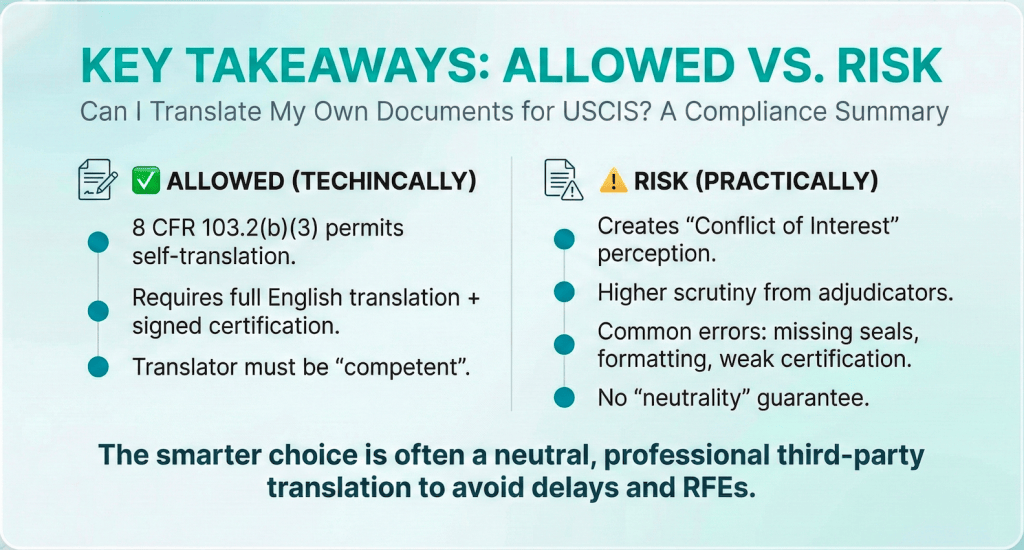
If you’re deciding whether to DIY, these two guides are worth reading before you take a risk:
If you already received a rejection or RFE related to translation, start here: USCIS rejected my translation (how to fix it).
FAQ
Does USCIS accept a digital (online) certified translation?
USCIS focuses on completeness, accuracy, and a proper translator certification. Many applicants submit a printout (for mail) or a PDF (for online upload) as long as the certification is included and the scans are legible.
Do certified translations “expire” for USCIS?
In general, a certified translation does not have an expiration date the way some forms do, but you should ensure the underlying document hasn’t changed (for example, a reissued certificate with new notes or stamps). For a deeper explanation, see: How long is a certified translation valid for USCIS?
What if my marriage certificate is partly illegible?
Rescan if possible. If something is still unreadable, a transparent note like “[illegible stamp]” is typically safer than omitting the stamp entirely, because it proves you translated everything visible and did not selectively remove content.
My spouse’s name spelling differs across documents. Should the translation “match the passport”?
The translation should accurately reflect what the marriage certificate shows. If you have inconsistent spellings across documents, handle that with additional evidence (and, if appropriate, a brief explanation), rather than rewriting the marriage certificate in English to “make it consistent.”
Next step: If you want the fastest low-risk path, use a USCIS-oriented workflow and keep your evidence clean: Get a certified translation online.
External references (official / authoritative):