Disclaimer: This article provides general information about USCIS translation requirements and filing practice. It is not legal advice. If your case includes admissibility issues, prior denials, or deadline risks, consult a licensed U.S. immigration attorney.
About the author: Erin Chen is Co-Founder and Translation Strategist at CertOf™. She has spent 10+ years building certified document translation workflows for immigration filings and RFE responses.
USCIS rejected my translation: fast, compliant, and no-second-RFE fix path
If you are here because ‘USCIS rejected my translation’ appeared in your notice, your case is usually still recoverable. This is one of the most stressful points in any immigration timeline: you already paid filing fees, waited months, and now a translation issue threatens everything. The good news is that most translation RFEs are fixable in one business day when you correct the exact defect instead of redoing the whole packet blindly.
As of February 28, 2026, the legal baseline has not changed: USCIS still relies on 8 CFR 103.2(b)(3) and USCIS evidence guidance. In practice, digital intake and scan quality checks surface weak certificates, cropped scans, and incomplete layout translation earlier in the workflow.
Key takeaways if USCIS rejected my translation
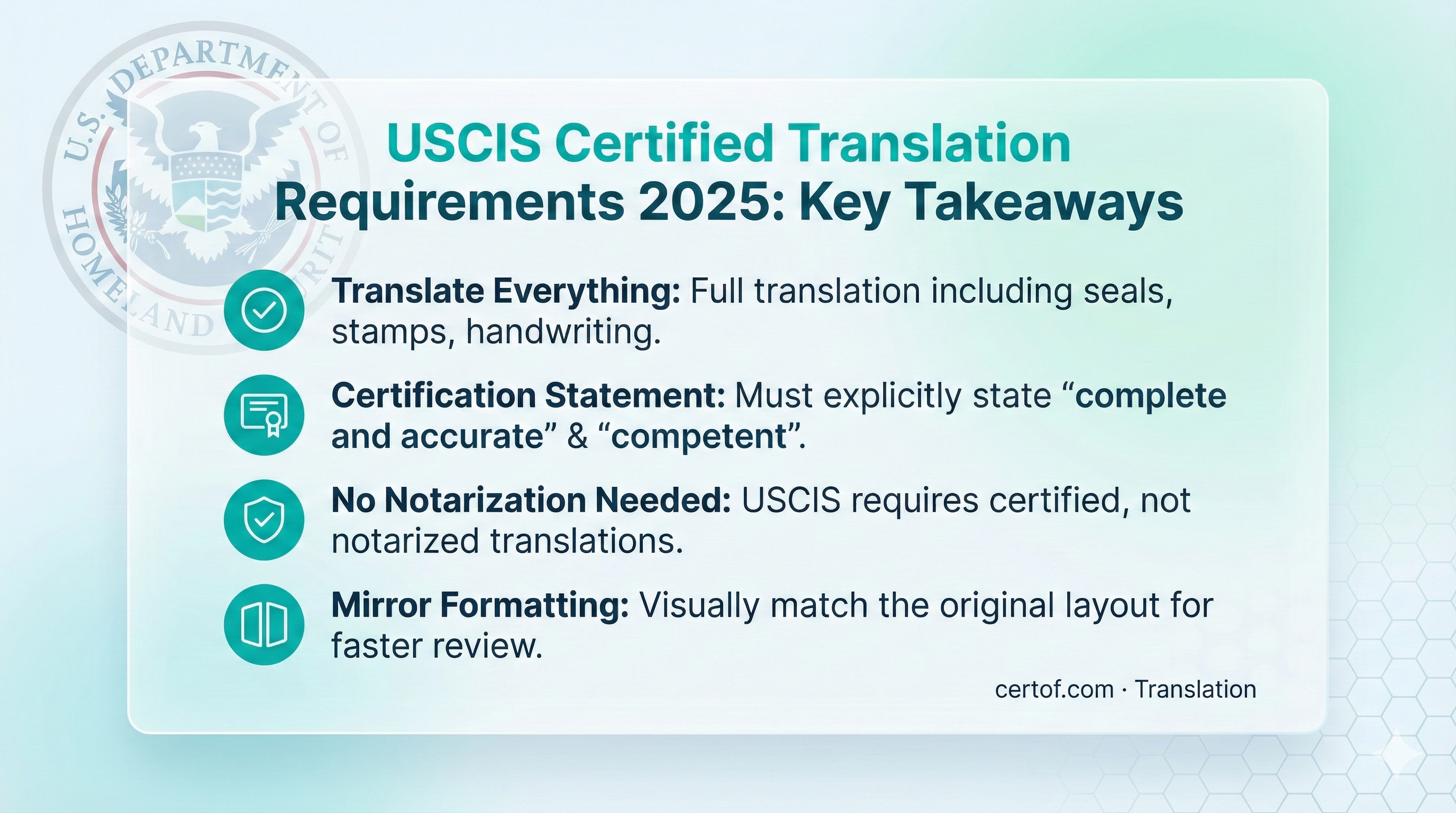
- Core rule: Foreign-language evidence must include a full English translation plus a translator certification of competence and accuracy under 8 CFR 103.2(b)(3).
- Most common failure: The translation text is usable, but the certificate of translation accuracy is missing, vague, unsigned, or signed by the wrong person.
- Counter-intuitive truth: Fancy paper, wet seals, and notary stamps do not guarantee acceptance. USCIS checks completeness and certification language, not visual design.
- Fast recovery: A targeted USCIS RFE translation service can produce a clean response packet quickly, helping you hit the deadline on your notice.
Common questions this guide answers
- What should a certificate of translation accuracy include?
- Does USCIS accept digital certified translations?
- Can I translate my own documents for USCIS?
- Do I need original documents with certified translation?
- Can I reuse a certified translation for multiple USCIS cases?
Who this guide is for (and why this hurts so much)
This update is written for applicants and families handling I-130, I-485, N-400, K-1, and related filings under deadline pressure. The pain points are predictable: fear of denial, uncertainty about what USCIS really wants, and concern about paying twice for translation. My goal here is practical: isolate the defect, fix only what matters, and cut delay risk.
What USCIS actually requires (official sources only)
- Regulation: Under 8 CFR 103.2(b)(3), each foreign-language document must be accompanied by a full English translation and translator certification.
- Policy Manual: USCIS states that partial translations are generally not acceptable, with limited exceptions for official extracts. See USCIS Policy Manual, Volume 1, Part E, Chapter 6.
- Scan quality: Poor paper filing quality can slow intake and review. See Recommendations for Paper Filings to Avoid Scanning Delays.
- Originals vs copies: USCIS filing instructions generally require copies unless originals are specifically requested. See Form Filing Tips.
Practical point: in 2026, digital comparison workflows can flag layout and metadata mismatches before deeper substantive review. Missing side notes and untranslated stamps are common triggers.
Counter-intuitive but true: an official extract may pass, your ‘helpful summary’ may fail
Many applicants assume shorter is safer. In USCIS translation work, that is often wrong. An official extract issued by a competent records authority can be acceptable in context, but a translator-created summary that omits fields, seals, or annotations usually fails review. This single misunderstanding causes avoidable second-round RFEs.
7 reasons USCIS rejected my translation (and how to fix each one fast)
1) Missing or defective certificate of translation accuracy
Why it gets flagged: The certification does not clearly state translator competence plus completeness and accuracy, or it lacks signer name, signature, and date.
Fast fix: Re-issue with compliant language and complete signer details. Use this internal checklist: USCIS certified translation requirements.
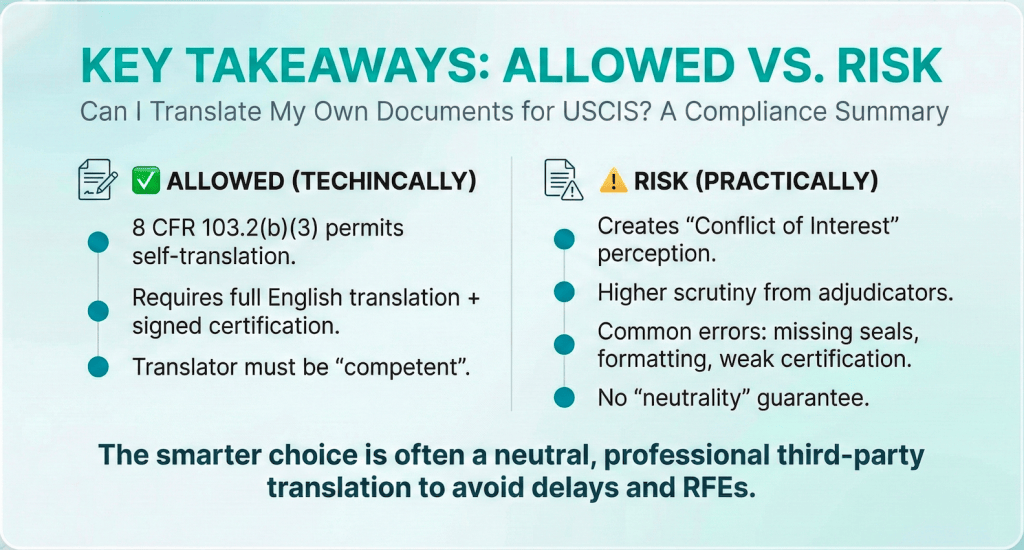
2) Self-translation or family translation (conflict risk)
Why it gets flagged: The applicant, spouse, or close relative signed the certificate. Even with strong language skills, this introduces credibility concerns.
Fast fix: Use an independent translator or agency and submit a fresh certified version. Related guide: Can I translate my own documents for USCIS?
3) Summary translation instead of complete translation
Why it gets flagged: Multi-field records such as Chinese Hukou, Japanese Koseki Tohon, and Korean Family Relation Certificate are reduced to key facts only.
Fast fix: Replace with a full line-by-line translation including blank fields, side notes, and page headers. For expected structure, review this USCIS certified translation sample.
4) Stamps, seals, back-side notes, or margins were not translated
Why it gets flagged: Officers cannot determine whether omitted text changes legal meaning (for example duplicate, void, amended, or issuing authority restrictions).
Fast fix: Use mirror formatting and bracketed annotations such as [Seal: Civil Registry, Province X] and [Stamp: Issued on YYYY-MM-DD].
5) Name/date inconsistency across forms and translated evidence
Why it gets flagged: Transliteration drift or mixed date formats across forms, passport data, and civil records can look like identity mismatch.
Fast fix: Set one master spelling from passport data, then normalize every translated record (including marriage certificate translation and birth record pages) to that same standard.
6) Raw AI output with no human certification
Why it gets flagged: Machine-only output can miss legal context and cannot satisfy human certification requirements by itself.
Fast fix: Use human-reviewed certified translation. Background reading: Can I use Google Translate for USCIS?
7) Poor source file quality or wrong RFE packet assembly
Why it gets flagged: Cropped photos, blur, low contrast, or missing source pages prevent verification. Another common mistake is sending translation pages without clear source-page pairing.
Fast fix: Rescan in color at readable resolution, pair source and translation pages in order, and verify layout using a USCIS certified translation sample before submission.
Pitfalls that cause second RFEs, delays, or extra cost
- ‘I notarized it, so it should pass’: Notarization verifies identity, not translation accuracy. Typical result: unresolved RFE. See certified vs notarized translation.
- Submitting only translated pages: Officers cannot cross-check source text. Typical result: follow-up request and delay.
- Using summary-only vendors: Missing seals and margins force a full redo. Typical result: paying twice.
- Ignoring the exact RFE language: Broad resubmission without fixing the stated defect. Typical result: second RFE or denial risk.
- Waiting until the final week: Any courier or scan issue becomes high risk near deadline.
CertOf vs traditional agencies: speed, compliance, and cost
| Feature | CertOf certified translation services | Traditional agency / law office workflow |
|---|---|---|
| Typical turnaround | 5-10 minutes for many standard USCIS documents | 24-72 hours is common |
| Price model | $9.99/page transparent pricing | Often higher per-page plus rush fees |
| Acceptance confidence | 100% USCIS acceptance guarantee + refund policy | Varies by provider |
| Formatting quality | Mirror formatting with stamps and seals annotations | Plain text output is common |
| Ordering process | Fully online upload and delivery | Email and manual back-and-forth |
3-step process to fix rejected USCIS translation today
- Upload: Submit your source document plus RFE page through the online USCIS certified translation services portal.
- Confirm: Verify master spelling, date format, and response packet type.
- Download and file: Receive the certified PDF, pair each translation with its source page, and submit before the notice deadline.
Trust and operations: privacy, institution coverage, and rush support
- Privacy: Documents are processed through a secure workflow under the CertOf Privacy Policy.
- Institutions served: USCIS, universities, banks, employers, state agencies, and court-related submissions.
- Urgent cases: Rapid turnaround options are available for certified translation for request for evidence.
FAQ (People Also Ask)
Does USCIS accept digital certified translations?
In many filing channels, yes. For paper filings, applicants usually print the certified translation and include it with source copies. Follow the exact instructions on your form and notice.
What should a certificate of translation accuracy include?
It should include translator competence, completeness and accuracy language, translator name, signature, and date. Checklist: USCIS certified translation requirements.
Can I translate my own documents for USCIS?
It is high-risk because neutrality can be questioned. A third-party translator is the safer option. Details: Can I translate my own documents for USCIS?
Do I need original documents with certified translation for USCIS?
Usually copies are filed unless USCIS asks for originals. Practical guidance: do I need original document with certified translation.
Can I reuse a certified translation for multiple USCIS cases?
Often yes, if the source document and personal details are unchanged. Checklist: reuse certified translation for multiple USCIS cases.
Clear the RFE now: practical CTA
If your notice says USCIS rejected my translation, do not panic and do not overcorrect. Fix the exact defect, submit a compliant packet, and move your case forward. Start with online USCIS certified translation services, review certified translation pricing, and confirm terms under the 100% USCIS acceptance guarantee and refund policy. For custom workflows, contact immigration translation support.
Authoritative references
- 8 CFR 103.2(b)(3): English translation and translator certification rule
- USCIS Policy Manual (Evidence / Translations): Volume 1, Part E, Chapter 6
- USCIS Filing Quality Guidance: Recommendations for Paper Filings
- USCIS Form Filing Tips: Copies, signatures, and packet preparation basics