Disclaimer: This article provides general information about USCIS translation rules and filing practice. It is not legal advice. For case strategy, inadmissibility issues, or NOID response planning, consult a licensed U.S. immigration attorney.
About the author: Erin Chen is Co-Founder and Translation Strategist at CertOf. Our team reviews USCIS translation packets daily, including RFE repair cases involving birth certificates, marriage records, and household registration documents.
Can I Translate My Own Documents for USCIS? 2026 Rules, RFE Risks, and the Safer Low-Cost Path
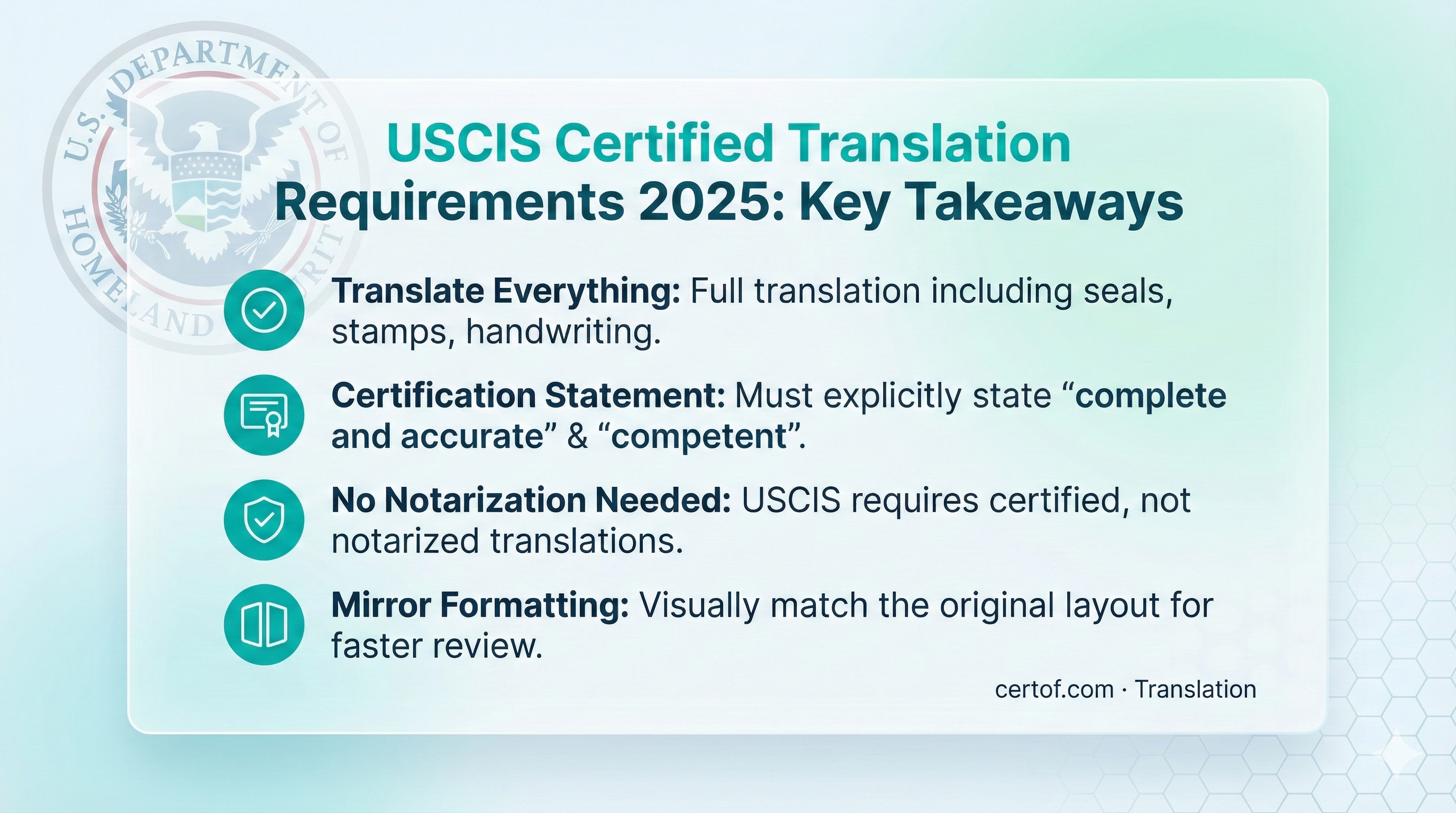
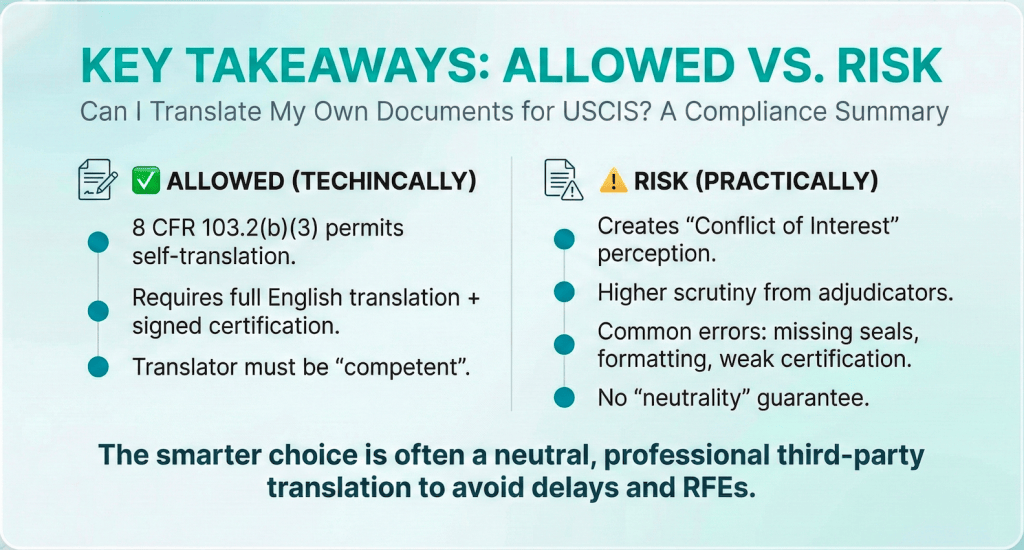
If you are filing Form I-130, I-485, N-400, or I-129F and asking can i translate my own documents for uscis, you are asking the right cost-versus-risk question. The regulation does not expressly ban self-translation, but USCIS still requires a full English translation plus a signed certification of completeness, accuracy, and translator competence.
- Quick answer: Self-translation may be possible, but it carries avoidable risk in core identity and relationship evidence.
- Rule that controls: 8 CFR 103.2(b)(3) requires full translation and translator certification.
- Most expensive mistake: Missing stamps, back-page notes, or handwritten annotations can trigger an RFE and add months to your timeline.
- Low-risk option: Use a third-party order USCIS certified translation online workflow with mirror formatting and document-specific certification.
What USCIS Actually Requires Under Federal Rule
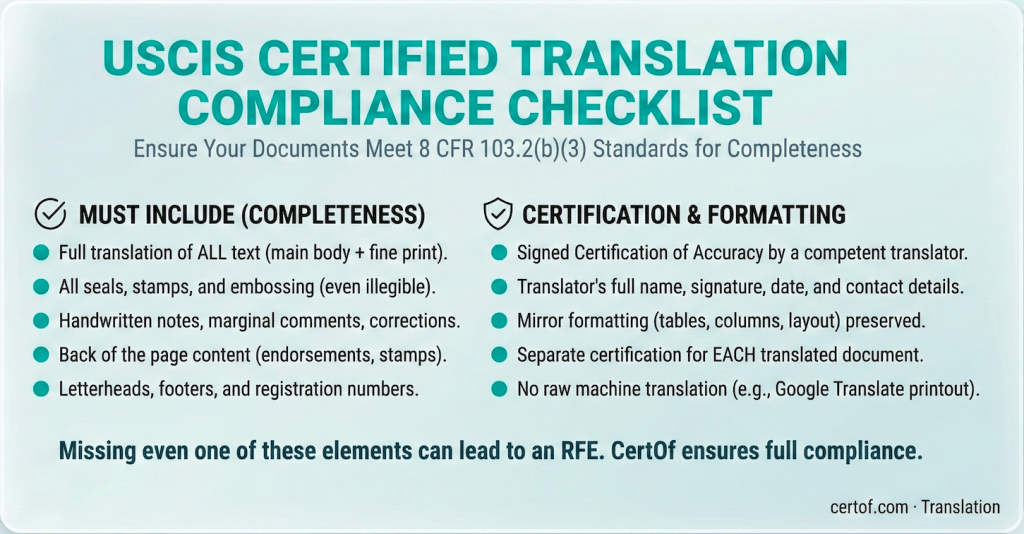
The controlling regulation is 8 CFR 103.2(b)(3): foreign-language documents must include a full English translation and a translator certification stating the translation is complete and accurate and the translator is competent. USCIS repeats this in Tips for Filing Forms by Mail and Five Steps to File at the USCIS Lockbox.
The USCIS Policy Manual, Volume 1, Part E, Chapter 6 explains that missing initial evidence can lead to RFE, NOID, or denial in some scenarios. USCIS also highlights scan-ready evidence quality in its paper filing scanning guidance. In 2026, this is the practical reality: the rule text is stable, but sloppy evidence is easier to flag.
Counterintuitive but True: Strong English Alone Does Not Remove Risk
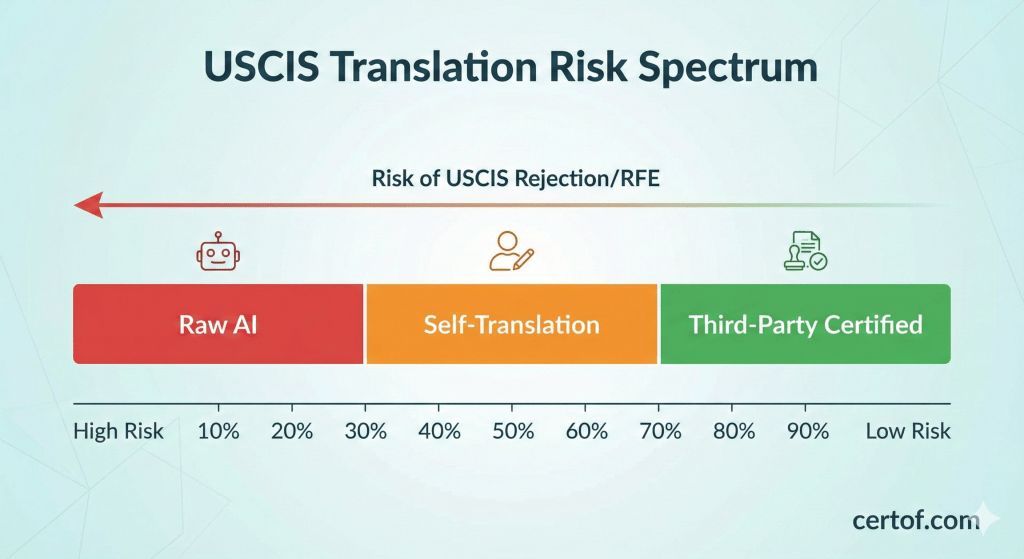
Even if your English is excellent, self-translating your own immigration evidence can still create credibility friction. Officers evaluate evidentiary integrity, not only wording quality. If the translator and beneficiary are the same person, inconsistencies can attract extra scrutiny.
Another counterintuitive point: do not silently fix source-document errors in translation. If the original has a typo, translate faithfully and resolve inconsistencies separately in your packet.
Who This Guide Is For and Where DIY Usually Fails
This guide is for cost-sensitive but risk-aware filers, including family-based applicants, adjustment applicants, K-1 couples, and naturalization applicants who cannot afford rework.
If your packet includes birth certificate translation for USCIS, marriage certificate records, household registers, police certificates, or divorce decrees, translation quality control is not cosmetic. It is part of eligibility evidence management.
Common Pitfalls That Trigger RFEs, NOIDs, or Delay Cycles
- Partial translation: Front page translated, reverse side ignored.
Consequence: RFE for incomplete evidence and a new response cycle. - Stamp and seal omissions: Faint stamps, embossed marks, or handwritten side notes skipped.
Consequence: officer challenges document completeness. - Generic one-line certification: No clear competence statement and weak traceability.
Consequence: technical noncompliance and paid rework. - Machine output submitted as final: No accountable human certification block.
Consequence: translation evidence may be rejected. - Name or date mismatch across forms and translations: Inconsistent transliteration or ambiguous date format.
Consequence: extra scrutiny and potentially longer adjudication.
If you already received a notice, use a repair checklist before resubmitting: what to do when USCIS rejected my translation and uscis rfe translation services response guide.
Can I Use Google Translate for USCIS?
You can use machine translation for private drafting, but not as final filing evidence. USCIS requires a certified human translation with a signed statement of accuracy and competence. For detail, see can i use google translate for uscis, do i need ata certified translator for uscis, and USCIS certified translation sample.
- Acceptable: draft understanding and internal triage.
- Not acceptable as final submission: unreviewed machine output without compliant certification.
- Safer workflow: human-reviewed certified translation with mirror layout and document-level declaration.
CertOf vs DIY vs Traditional Agency: Cost, Speed, and Acceptance Risk
| Decision factor | CertOf | DIY self-translation | Traditional agency or law-firm vendor |
|---|---|---|---|
| Typical turnaround | 5-10 minutes for common USCIS documents | Several hours plus formatting work | Usually 24-72 hours |
| Pricing model | document certified translation pricing at $9.99/page | Low cash cost, high time and risk cost | Often higher and variable by provider |
| Compliance package | Document-specific certification plus mirror formatting | High omission risk | Varies by vendor |
| Acceptance protection | USCIS acceptance guarantee and refund policy | No external quality control | Depends on contract terms |
| Online convenience | Upload, pay, download | Fully self-managed | Often email back-and-forth |
3-Step USCIS-Safe Workflow for Applicants Who Need Speed
- Upload: Submit a scan or phone photo through the online USCIS certified translation portal.
- Pay: Confirm page count and transparent certified translation pricing.
- Receive: Download your certified PDF package with translator declaration and layout-preserved formatting.
Trust and delivery details that matter in real filings
- Privacy: Data handling transparency through the CertOf privacy policy.
- Coverage: USCIS, universities, banks, and courts.
- Urgency: Rush handling for tight deadlines and RFE responses.
- Terminology clarity: Review difference between certified and notarized translation before paying for unnecessary notarization.
Need multi-document help? Contact expedited certified translation support.
FAQ: People Also Ask
Can a friend or family member translate my USCIS documents?
The translation rule does not list a prohibited family relationship in its text, but practical risk is usually higher when neutrality is unclear. For role standards, see who can certify a translation for uscis: https://certof.com/resources/immigration-uscis/who-can-certify-a-translation-for-uscis/.
Does USCIS accept online certified translations?
In most filings, yes, if the translation is legible, complete, and properly certified. Always follow your form-specific instructions: https://certof.com/resources/immigration-uscis/uscis-certified-translation-requirements/.
Do I need an ATA certified translator for USCIS?
USCIS does not require ATA membership in the core regulation. It requires translator competence and a proper certification statement. See https://certof.com/resources/immigration-uscis/do-i-need-ata-certified-translator-for-uscis/.
Do I need to send original documents with certified translation?
Usually no for initial filing unless instructions or USCIS explicitly request originals. See https://certof.com/resources/immigration-uscis/do-i-need-original-document-with-certified-translation-uscis/.
What if USCIS rejected my translation already?
Submit one corrected, complete response package that addresses every cited defect at once. Use https://certof.com/resources/immigration-uscis/uscis-rejected-my-translation/ and https://certof.com/resources/immigration-uscis/uscis-rfe-translation-services/.