What Counts as a Certified English Translation for U.S. Family Immigration Cases?
If you are dealing with marriage certificates, birth certificates, household registers, divorce decrees, police records, or adoption papers for a family-based U.S. immigration case, the question is usually not “Do I need a notary?” It is whether your packet includes a certified English translation for U.S. family immigration that matches the rule used by the agency reviewing your case. In the United States, the core standard is federal, not state-by-state: for USCIS filings, the baseline comes from 8 C.F.R. § 103.2(b)(3); for consular processing, the State Department applies its own NVC civil document rule; and for immigration court filings, EOIR follows its practice manual.
That nationwide rule does not mean every family case feels the same in real life. Families get delayed because they reuse the wrong template, upload unreadable scans, pay for unnecessary notarization, or mix up the USCIS rule with the NVC rule. This guide focuses on those practical problems first, then shows where certified translation actually matters.
Key Takeaways
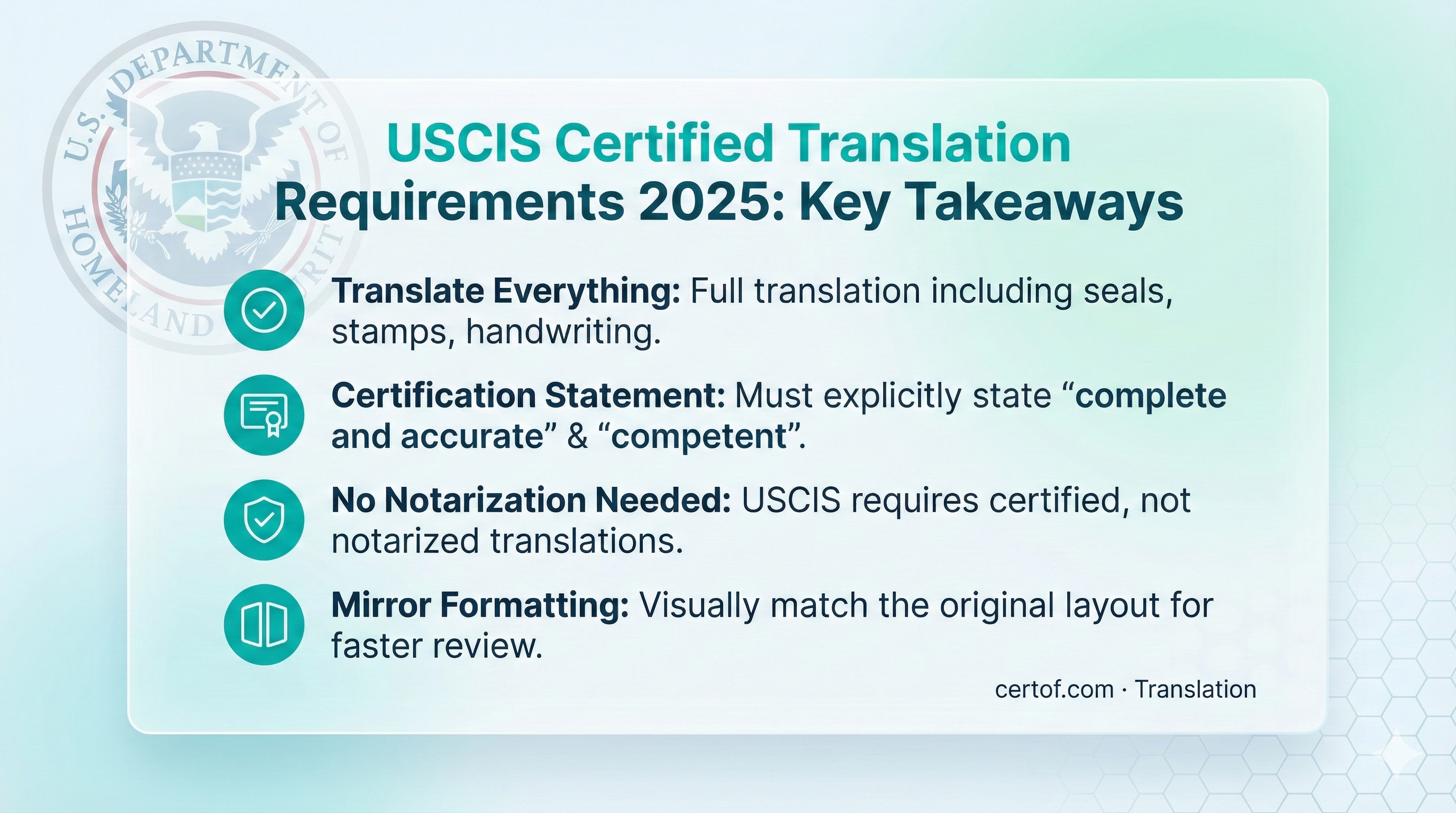
- For most USCIS family cases, a compliant translation means a full English translation plus the translator’s signed statement that the translation is complete, accurate, and that the translator is competent to translate.
- Notarization is usually not the issue. USCIS, NVC, and EOIR do not make notarization the core requirement for ordinary family-case translations.
- Who can translate? Federal rules do not require an ATA translator, a court interpreter, or a lawyer. The real issue is competence, completeness, and a proper certification statement.
- The big exception: at the NVC stage, a document in the official language of the country where the visa application is being made may not need an English translation, even though USCIS would require one.
Who This Guide Is For
This guide is for people handling family-based immigration matters across the United States, especially spouses, parents, adult children, sponsors, paralegals, and nonprofit caseworkers dealing with non-English civil documents. The most common language pairs in this context include Spanish-English, Chinese-English, Portuguese-English, Vietnamese-English, Korean-English, and other non-English combinations tied to family-based filings.
The usual document set includes birth certificates, marriage certificates, divorce decrees, household or family registry records, police certificates, passport biographic pages, and sometimes adoption or custody orders. The typical stuck situation is simple: a bilingual relative wants to translate, a notary tells the family notarization is required, or the applicant does not know whether USCIS, the National Visa Center, and immigration court follow the same translation rule.
Where Families Actually Get Stuck
Because this is a federal issue, the legal standard is nationally consistent. The real friction is operational. Families run into problems when they:
- translate only the main text but skip stamps, seals, handwritten notes, side annotations, or back pages;
- use a generic certificate that says the translation is “true” but does not say the translator is competent to translate;
- pay for a notarized translation because someone in the community says “USCIS needs a notary seal”;
- apply the NVC language rule to a USCIS filing, or vice versa;
- mail paper packets that scan poorly or upload CEAC files where the original and translation are not clearly readable.
USCIS itself warns filers to keep mail packets readable, properly signed, and easy to scan on its mail filing guidance page. That matters for translations because a perfect certification statement does not help if the underlying document or seal is unreadable in the scan.
What Counts as a Certified English Translation for U.S. Family Immigration?
For ordinary USCIS family filings, the safest plain-English definition is this: a certified translation is a full English translation of the foreign-language document, accompanied by a signed statement from the translator saying the translation is complete and accurate and that the translator is competent to translate from the foreign language into English under 8 C.F.R. § 103.2(b)(3).
That is why the word certified often misleads families. It does not usually mean state-certified, court-certified, ATA-certified, or notarized. It means the translation package includes the translator’s certification. If you need the broader USCIS baseline, see our related guides on USCIS certified translation requirements, who can certify a translation for USCIS, and certified vs. notarized translation.
USCIS vs. NVC vs. Immigration Court
| Path | Main rule | What matters most | Common mistake |
|---|---|---|---|
| USCIS | Foreign-language documents need a full English translation with a complete/accurate and competent translator certification. | English translation must be complete, readable, and properly certified. | Thinking a notary seal can replace the translator’s statement. |
| NVC / Consular processing | Documents not in English or not in the official language of the country of application need a certified translation. | Check whether the document language matches the official language of the interview country. | Paying for unnecessary English translations because the USCIS rule was applied to the NVC stage. |
| EOIR / Immigration court | Translation must be certified, typed or printed legibly, and usually include translator contact details. | The certification format is stricter. | Reusing a USCIS-style certificate without the extra court-facing details. |
Understanding this three-path split is critical for family applicants. Many families move from petition stage to visa stage without realizing the language rule can change. The State Department’s own NVC civil document guidance is the source for that official-language exception. EOIR’s court-facing format requirements are spelled out in the EOIR practice manual.
Who May Translate?
For ordinary family immigration filings, the federal rule does not require an ATA member, a government-approved translator, or an immigration lawyer. In that sense, translator eligibility is broad. But broad eligibility is not the same as low risk.
In practice, there are three common options:
- A professional document translation service: usually the easiest way to get a standard certificate, consistent formatting, and help with seals, stamps, and back pages.
- A bilingual friend or relative: legally plausible under the rule if competent, but often riskier when the family is already nervous about bias, formatting, or missing content.
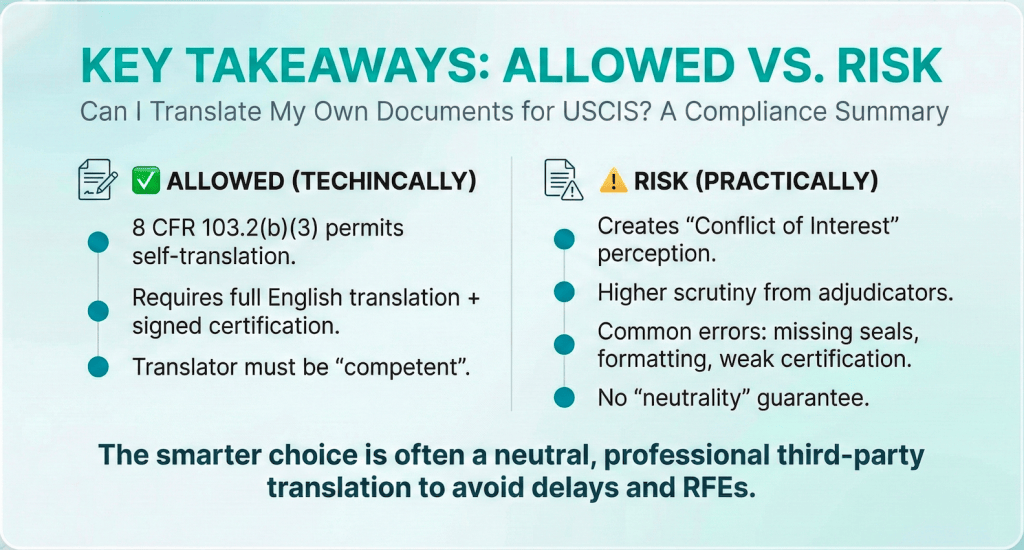
- Self-translation: the regulation does not expressly ban it, but it is a weak point in many family packets because the person with the most at stake is also the one certifying the translation.
If you want the narrower USCIS discussion, our existing pages on self-translation for USCIS and whether ATA is required cover that issue in more detail. In the context of family immigration, the practical point is simple: family cases often involve relationship-sensitive documents, so the cost of a bad translation is not just technical noncompliance. It can slow the entire case.
What the Certification Should Cover
For USCIS-style family packets, the certification statement should clearly do two jobs: confirm that the translation is complete and accurate, and confirm that the translator is competent to translate into English. A plain USCIS-style wording is:
I certify that I am competent to translate from [language] into English, and that the attached translation is a complete and accurate translation of the original document.
For immigration court filings, do not assume the same one-line statement is enough. EOIR expects a more formal presentation and, in ordinary practice, families are safer using a typed certificate with signature and contact information consistent with the EOIR manual.
Why Notarization Is Usually the Wrong Question
This is the most common family-immigration translation myth in the United States. A notary public verifies identity and signatures. That is not the same thing as certifying the accuracy of a translation. In other words, a notary can witness a person signing a translator statement, but the notary does not turn an incomplete or noncompliant translation into an acceptable one.
This matters because many family immigrants come from legal systems where notarial practice is central. They understandably assume U.S. immigration works the same way. It usually does not. For ordinary family filings, the core requirement is the translator’s certification, not a notarization. If you need the longer comparison, our certified vs. notarized translation guide goes deeper.
Typical Family Immigration Documents That Need Extra Care
- Marriage certificates: watch for registry numbers, stamps, side notes, and prior-marriage references. See also marriage certificate translation for USCIS.
- Birth certificates: multilingual forms, registration notes, and parents’ names must line up cleanly. See birth certificate translation.
- Divorce decrees and death records: these often complete the relationship chain and are easy to under-translate.
- Household registers and family relation records: these are high-risk because they often compress multiple family relationships into one page.
- Adoption, custody, or name-change records: these can be decisive in parent-child cases and often contain handwritten or court-issued annotations.
In family cases, the translation problem is usually not vocabulary. It is completeness. One missing court annotation on an old divorce order can create weeks of delay if USCIS or the consular post thinks the relationship chain is still unclear.
How the Process Works in Real Life
- Identify your path: USCIS, NVC, or immigration court.
- Pull the full document set before translating. Do not translate the marriage certificate and forget the prior divorce decree or the child’s birth record.
- Translate the full document, including stamps, seals, handwritten notes, and back pages where relevant.
- Attach the correct certification format for the path you are using.
- Submit readable copies. For paper USCIS filings, follow the agency’s own scanning and assembly guidance on its mail filing page.
- Keep the source scan, the translation, and the certification page together in your digital master file for RFEs, interviews, and later stages.
There is usually no government appointment just for translation. Translation is a private preparation step. The government-facing parts are the filing systems: myUSCIS or lockbox intake, CEAC for NVC uploads, and court filing rules for EOIR matters. That means timing and quality control are on the family, the preparer, and the translation provider.
Cost, Wait Time, Mailing, and Scheduling Reality
There is no separate USCIS translation filing fee. Government costs come from the underlying immigration form, not from the translation itself. Private translation pricing varies widely, so families should compare scope rather than just headline price: Does the service include the certification page, revisions, seal handling, back-page handling, and clear PDF delivery?
Wait time is also mostly private-market driven. For the government side, the bigger risk is avoidable delay: unreadable scans, mixed-up original and translation pages, or paper packets assembled in a way that scans badly. For NVC uploads, the practical challenge is different: the original and the translation both have to be easy to read, and over-compressed PDFs can create preventable rejections.
What Real Applicants Keep Reporting
Across long-running family-immigration discussions on VisaJourney, lawyer answers archived on Avvo, and newer threads on Reddit, the same problems keep repeating: families leave out seals or back pages, use incomplete certification wording, or spend money on notarization that does not solve the real compliance issue.
Those community sources are not the legal rule, but they are useful reality checks. They show where ordinary filers get tripped up: not by obscure legal theory, but by document handling, bad templates, and path confusion between USCIS and NVC.
Fraud Risks and Complaint Paths
USCIS openly warns the public about immigration scams on its Avoid Scams page. This matters for translations because “notario” and document-preparer scams often bundle three things together: translation, notarization, and unauthorized legal advice. Those are not the same service.
- If you need general multilingual information about immigration processes, USCIS offers a Multilingual Resource Center. It is helpful for guidance, but it does not translate your personal civil documents.
- If a family case is already in immigration court and someone is posing as an authorized representative, EOIR’s fraud and abuse channels are relevant.
- If you paid a scammer, the FTC’s immigration-scam guidance and your state attorney general’s consumer complaint path are the right next steps.
A simple rule for families: if someone says only a notary, only a lawyer, or only a secret “USCIS-approved translator” can produce an acceptable family-case translation, treat that as a red flag.
Why This Is Such a Big Issue Nationally
According to the DHS Office of Homeland Security Statistics 2024 Yearbook, family-based immigration consistently accounts for a very large share of new lawful permanent residents each year, often well above 400,000 people. Many of these applicants come from non-English-speaking countries. That is why translation errors show up so often in ordinary family files: the document burden is relationship-heavy, and relationship proof often depends on older civil records that are messy, stamped, annotated, or multilingual.
In other words, this is not a niche paperwork issue. It is a routine pressure point in a very large national filing category.
Commercial Translation Providers: Objective Comparison
For ordinary family cases, the default question should be: who is most likely to deliver a complete English translation plus the right certification wording without turning notarization into a fake requirement? The table below separates objective public signals from marketing claims. Public review profiles, where they exist, are customer-service signals only, not proof of legal adequacy.
| Provider | Public contact signal | Typical fit for family cases | What to check before ordering |
|---|---|---|---|
| CertOf | 2500 Wilshire Blvd., Los Angeles, CA 90057; +1 (650) 468-7435; online ordering at translation.certof.com | Families who want digital certified document delivery, standard certification wording, and support for seals and layout-sensitive records. | Confirm the package covers back pages, handwritten notes, and revision handling. Related service pages: how online ordering works and revision and turnaround policy. |
| RushTranslate | Seattle contact signal; (206) 672-5052; ATA directory listing and BBB-accredited public profile | Families who want a mainstream national online option focused on USCIS-style certified document workflows. | Check whether you need notarization as an add-on for a separate reason, because ordinary USCIS family cases usually do not. |
| Day Translations | 477 Madison Avenue, 6th Floor, New York, NY 10022; 1-800-969-6853 | Families comparing full-service national vendors and wanting an immigration-specific intake path. | Confirm who prepares the certificate, how revisions work, and whether relationship-chain documents are translated as one coordinated set. |
Public and Nonprofit Resources
| Resource | Who it helps | What it does | Boundary |
|---|---|---|---|
| USCIS Multilingual Resource Center | Applicants with limited English proficiency | Provides multilingual guidance about immigration benefit processes and scam awareness. | Does not translate your personal documents. |
| DOJ Recognition & Accreditation / EOIR | Families who need legal help, not just translation | Helps users identify recognized organizations and accredited representatives. | This is about legal representation eligibility, not translator certification. |
| FTC immigration scam guidance | Victims of notario or document-preparer fraud | Explains how to report scams and get legitimate help. | Useful when a provider used “notarization” or fake legal authority to upsell unnecessary services. |
FAQ
Does USCIS require a notarized translation for family immigration?
No. The core USCIS requirement is a full English translation plus the translator’s certification of accuracy and competence, not notarization.
Can I or my spouse translate our own marriage certificate?
The rule does not expressly ban that, but it is often a risky choice in a family case because the same people with the strongest personal stake are also creating the certified translation. Many families prefer a neutral third party.
Do I need an ATA-certified translator for an I-130 or I-485 packet?
No. ATA membership or certification is not the legal requirement. What matters is a complete translation and a proper translator certification.
What if my document has stamps, side notes, or writing on the back?
Translate them. In family cases, these small details are often what tie the relationship record together.
Does NVC require English if my document is in Spanish and my immigrant visa interview is in Mexico?
Often no, because the State Department rule allows documents in the official language of the country of application. But that does not change the separate USCIS rule for earlier stages.
Need Help With the Translation Part, Not the Legal Strategy?
CertOf fits this topic best as a document-preparation and certified-translation provider, not as your legal representative. If your challenge is turning marriage, birth, divorce, police, or family registry records into a clean English packet with the right certification wording, you can start with CertOf’s online order flow. If your real problem is legal eligibility, filing strategy, or representation in immigration court, start with a lawyer or a DOJ-recognized legal service provider instead.
For related reading before you order, see how translation issues trigger RFEs, how to keep a reusable digital master, and what a USCIS-style sample looks like.
Disclaimer
This guide is for general information about document translation standards in family-based U.S. immigration matters. It is not legal advice, does not create an attorney-client relationship, and does not replace form instructions, agency guidance, or case-specific advice from a qualified immigration lawyer or accredited representative. Always verify the filing-stage rule that applies to your own path: USCIS, NVC, or EOIR.