Disclaimer: This article provides general information about USCIS translation requirements and professional best practices. It does not constitute legal advice. If your case involves complex legal issues, consult a qualified immigration attorney.
About the author: Erin Chen is the Co-Founder and Translation Strategist at CertOf™. With over a decade in bilingual editorial risk control and hands-on experience navigating the U.S. immigration process, Erin helps applicants prepare USCIS-ready certified translations that reduce avoidable delays.
Certified Translation of Japanese Koseki Tohon for Immigration: USCIS Checklist, Pitfalls, and Fast Online Workflow
Certified Translation of Japanese Koseki Tohon for Immigration: Fast, Compliant, and RFE-Safe
If you need a certified translation of japanese koseki tohon for immigration, the main risk is rarely simple language error. The real risk is missing legal context inside the register, such as family relationship lines, domicile history, side annotations, and official seals. This guide focuses on Koseki-specific execution so you can submit a cleaner packet on the first try.
Key Takeaways
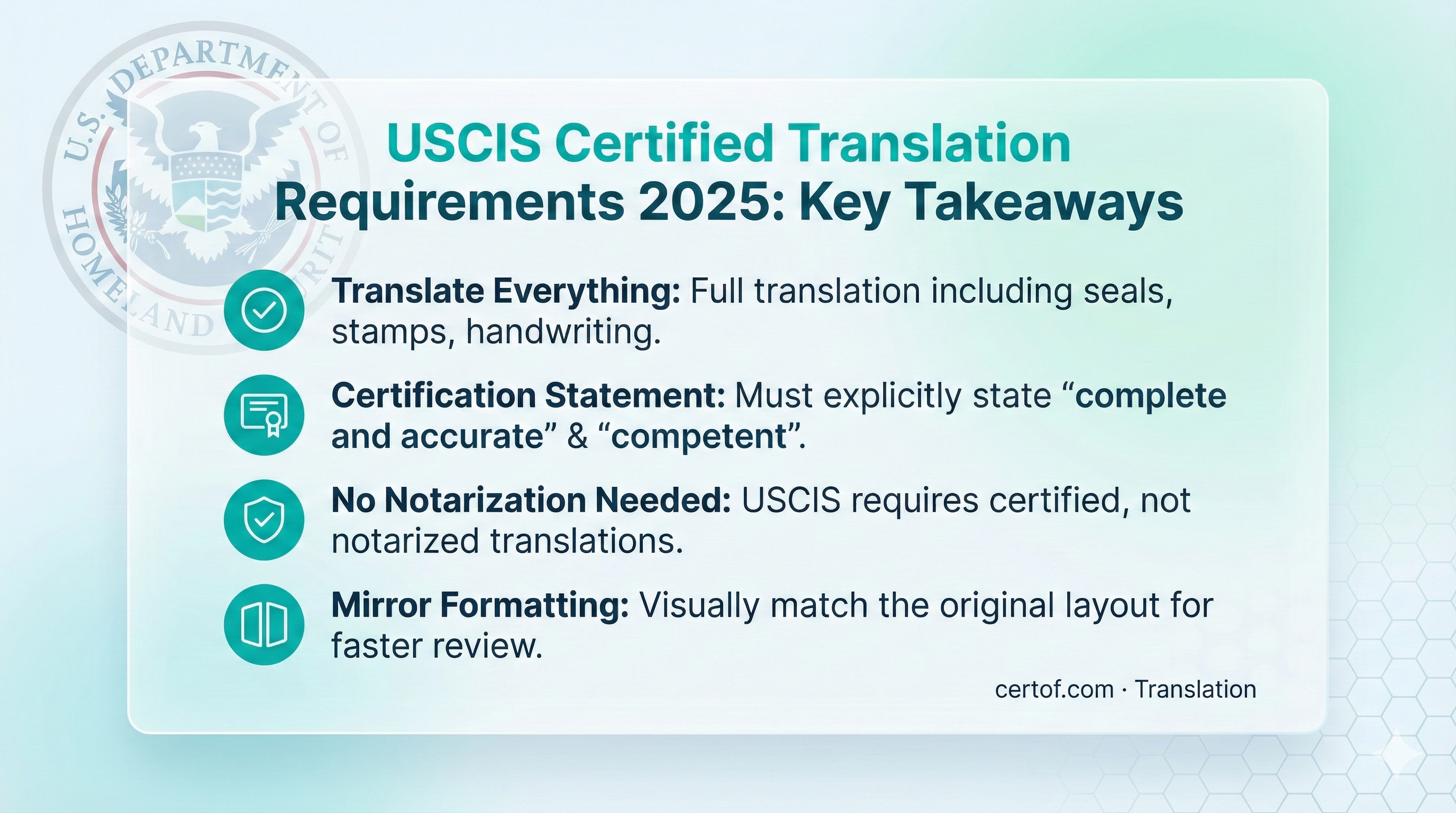
- USCIS baseline remains straightforward: full English translation plus a proper translator certification of accuracy and competence.
- Counterintuitive but practical: full Koseki Tohon is often safer than Shohon for family-based filings.
- As of February 24, 2026, official USCIS rules focus on completeness and certification wording; separate certification per document is still a strong risk-control best practice.
- CertOf workflow is simple: upload, pay, and receive a mirror-formatted certified file with transparent $9.99/page pricing and a published refund policy.
On This Page
- Who this guide helps
- What official sources require
- Tohon vs Shohon decision
- Koseki compliance checklist
- Common pitfalls and consequences
- CertOf vs traditional vendors
- FAQ
Who Needs This Japanese Koseki Translation Guide?
- Applicants preparing Form I-130 or Form I-485 packets with Japanese civil records.
- Couples and families concerned about delays caused by translation defects and missing civil-history context.
- Paralegals who need consistent, repeatable standards for immigration document translation.
- Anyone comparing japanese to english certified translation options under time pressure.
What USCIS and Official Sources Actually Require (As of February 24, 2026)
USCIS requires that foreign-language evidence include a full English translation and a translator certification stating the translation is complete and accurate and that the translator is competent. Source rule: 8 CFR 103.2(b)(3).
USCIS policy guidance also clarifies two points applicants often miss: official extracts are acceptable only if they contain all adjudication-relevant information, and translator-prepared summaries are not acceptable substitutes for complete translations. See USCIS Policy Manual, Volume 1, Part E, Chapter 6.
For Japan-specific document logic, the U.S. Department of State reciprocity page explains how full Koseki records and extracts are used, including domicile-transfer effects and when prior records may need a canceled-register extract. See Japan Reciprocity Schedule. Japan MOJ background: Family Registration (Koseki).
You may see third-party claims that USCIS created a newly titled formal rule called one certificate per document. I have not found that exact phrase as a new CFR section. Operationally, I still recommend separate certification per translated document to reduce ambiguity in multi-document packets.
The Counterintuitive Decision: Tohon vs Shohon
Many applicants choose Shohon because it is shorter and cheaper. For immigration, shorter is not always safer. If your case depends on proving relationship history across multiple family events, a full Tohon usually gives stronger evidence continuity and lowers follow-up risk.
Because Koseki can function as core evidence across life events, it is useful to cross-check related guidance for birth certificate translation, marriage certificate translation, divorce decree, and adoption decree evidence patterns.
For broader USCIS translation mechanics, see our USCIS certified translation requirements guide.
Koseki-Specific Compliance Checklist
| Koseki Element | Why It Matters | Execution Standard |
|---|---|---|
| Document type (Tohon/Shohon/Joseki) | Defines evidentiary scope | Translate exact title and keep Japanese term in parentheses |
| Honseki-chi (registered domicile) | Helps trace municipal record history | Translate all address lines and date markers without compression |
| Family relationship rows | Core logic for family-based petitions | Use mirror formatting so officers can compare row by row |
| Marginal notes and handwritten remarks | Can record divorce, adoption, or status changes | Translate fully; mark unreadable text as [illegible] |
| Seals and issuance details | Support authenticity and timing checks | Describe seal text where legible and preserve placement context |
| Era dates (Reiwa/Heisei) | Date mismatch can trigger follow-up | Show Gregorian date and preserve original era notation |
| Certification statement | Procedural compliance under USCIS rules | Include complete and accurate plus competent language, signature, and date |
Common Pitfalls and Practical Consequences
- Submitting a short extract when full family context is needed. Likely result: Request for Evidence (RFE) asking for additional civil evidence and re-translation.
- Skipping side notes, seals, or reverse-side text. Likely result: incomplete-translation objection and avoidable delay.
- Inconsistent English name spelling across documents. Likely result: identity mismatch review and extra clarification burden.
- Weak or generic certification wording. Likely result: translation package questioned on procedural grounds.
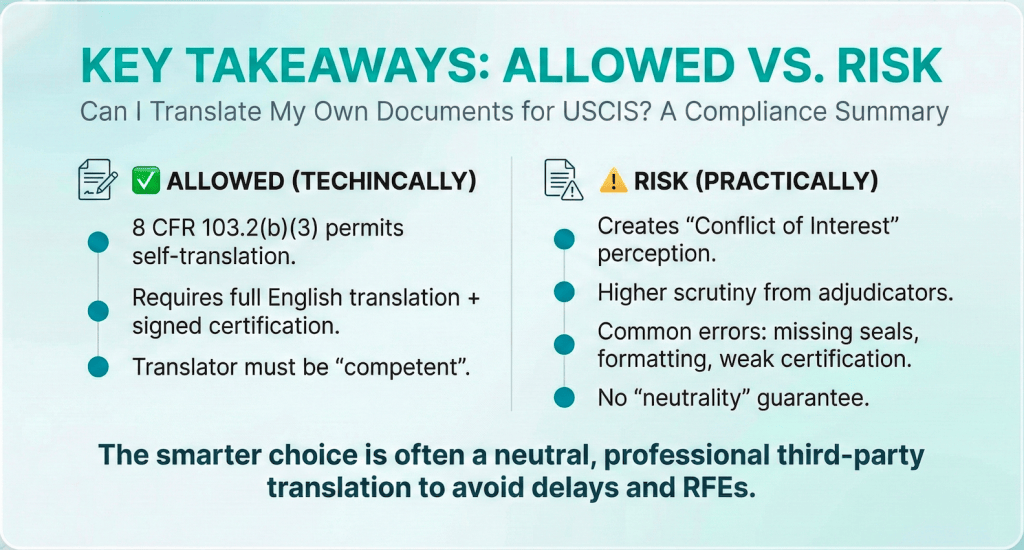
- Self-translation in a high-stakes filing. Likely result: avoidable credibility concerns even when language ability is strong.
If you are fixing a damaged packet, use USCIS RFE translation services checklist, USCIS rejected my translation fix guide, and USCIS certified translation sample.
CertOf vs Traditional Vendor: Time, Cost, and Risk
| Decision Factor | CertOf Workflow | Traditional Vendor Workflow |
|---|---|---|
| Turnaround | Typical fast delivery in 5-10 minutes for standard pages | Usually 24-72 hours or longer |
| Price | Transparent certified translation pricing ($9.99/page) | Quote-based and variable |
| Formatting quality | Mirror formatting for officer readability | Often plain text with weaker structure |
| Compliance posture | USCIS-focused package + refund and returns policy | Depends on individual provider |
| Ordering | Online upload and checkout | Email chains and office-hour bottlenecks |
For benchmark timing by document type, see fast certified translation benchmarks.
3-Step Ordering Flow
- Upload your file at order certified translation online.
- Review page count and pay using official per-page pricing.
- Receive certified PDF output and certificate package, then contact immigration translation support if your case has unusual annotations.
Privacy and Institution Coverage
- Review document handling in the privacy policy for certified translation services.
- Typical receiving institutions include USCIS, universities, banks, and courts, subject to each institution’s own acceptance rules.
- For mail filings, USCIS generally advises not sending originals unless specifically requested: USCIS filing guidance.
FAQ
Does USCIS accept online certified translations?
USCIS focuses on completeness, legibility, and valid certification language. Online delivery itself is not the issue if the package is compliant. See USCIS certified translation requirements.
Do I need original document with certified translation for USCIS?
For many filings, copies are accepted at filing stage and originals may be requested later. See do I need original document with certified translation USCIS.
Who can certify a translation for USCIS?
The standard is translator competence plus proper certification wording. See who can certify a translation for USCIS.
Can I translate my own Koseki for immigration?
Self-translation can create avoidable risk in high-stakes filings. See can I translate my own documents for USCIS and can I use Google Translate for USCIS.
Do I need notarization or an ATA-certified translator for USCIS?
USCIS does not require ATA membership as a legal mandate in 8 CFR 103.2(b)(3). Notarization is a separate concept from certification in most USCIS scenarios. See ATA translator requirement guide and certified vs notarized translation.
Ready to Submit with Lower RFE Risk?
Start with USCIS-oriented certified translation services, check transparent $9.99/page pricing, and review money-back policy terms before checkout.