Disclaimer: This article provides general information about USCIS translation requirements and professional best practices. It does not constitute legal advice. If your case involves complex legal issues, consult a qualified immigration attorney.
About the author: Erin Chen is the Co-Founder and Translation Strategist at CertOf™. With over a decade in bilingual editorial risk control and hands-on experience navigating the U.S. immigration process, Erin helps applicants prepare USCIS-ready certified translations that reduce avoidable delays.
Name change decree certified translation: fast, compliant, and built to avoid expensive filing mistakes
If your case includes a legal name change, your name change decree certified translation is the bridge between your past identity and your current legal identity. In real adjudication, officers usually do not reject because of wording style. They reject or question packets when the identity chain is broken across documents: old name, new name, decree effective date, and marital-status proof do not line up.
Need a fast start? You can order certified translation services online and upload your documents in minutes.
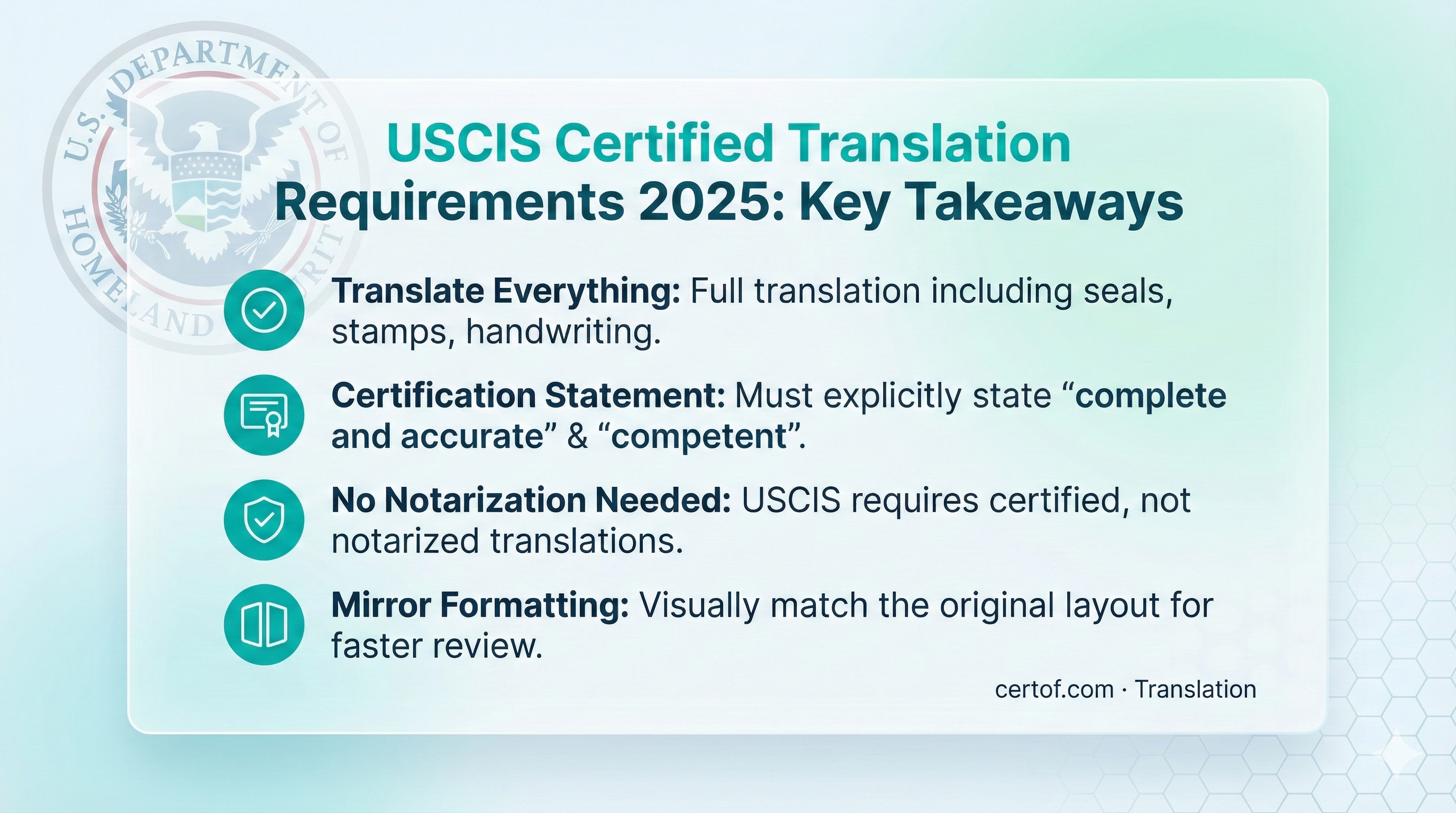
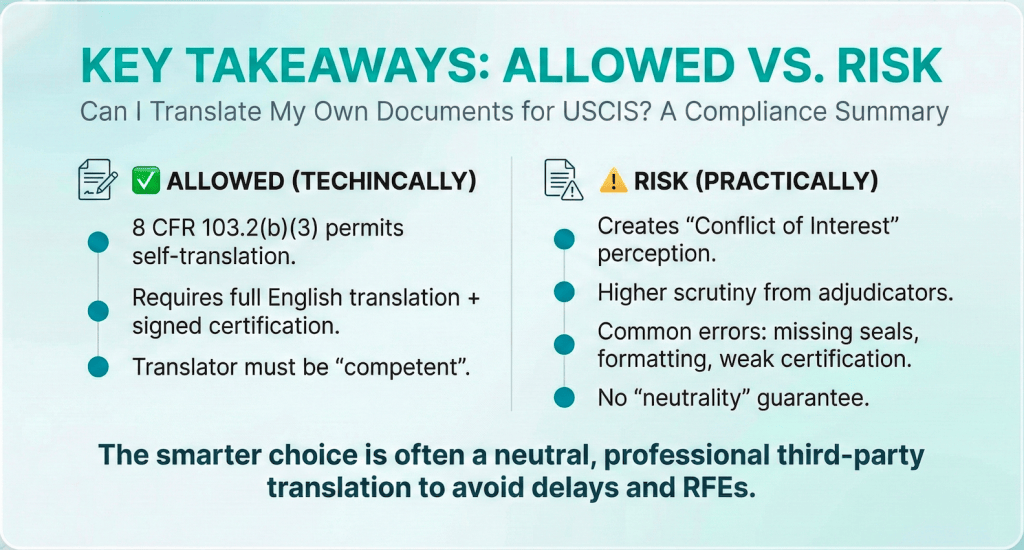
- USCIS requires full English translation plus translator certification for foreign-language documents under 8 CFR 103.2(b)(3).
- For USCIS filings, notarization is usually not the core requirement; completeness, accuracy, and translator competence certification are.
- Current USCIS signature policy confirms reproduced signatures can be valid, and electronic signatures are accepted for eligible e-filed requests when form instructions allow them (USCIS Policy Manual, Volume 1, Part B, Chapter 2).
- For marriage abroad, local authorities may require a single status certificate translation or certificate of no impediment to marriage translation with jurisdiction-specific format rules.
Who this guide is for
This guide is for couples and families handling marriage-related immigration evidence under time pressure, especially when one party has prior name changes, divorce history, or mixed-language civil records.
- You are preparing an I-130 or adjustment packet and need clear proof of legal name change.
- You are preparing marriage-abroad paperwork and need a single status certificate translation or certificate of no impediment to marriage translation.
- You want to avoid paying twice: once for rushed translation, then again for RFE-driven corrections.
How this article complements existing CertOf resources
To avoid repeating broad fundamentals, this article focuses on one high-risk intersection: name change decree plus single-status evidence. For full background, use these guides:
- USCIS certified translation requirements checklist
- Marriage certificate translation for USCIS guide
- Certified vs notarized translation explained
- Do I need original document with certified translation for USCIS
- Can I reuse certified translation for multiple USCIS cases
What official authorities actually require
| Authority | Rule in plain English | What to do in your packet |
|---|---|---|
| USCIS regulation | 8 CFR 103.2(b)(3) requires full translation plus translator certification of completeness, accuracy, and competence. | Translate the full decree and single-status document, including seals, notes, and endorsements. |
| USCIS signature policy | Policy Manual Chapter 2 states reproduced signatures can be valid; electronic signatures are accepted for eligible e-filed requests per instructions. | Do not delay filing only for wet-ink myths if your filing path and instructions permit reproduced or electronic signatures. |
| USCIS filing guidance | Tips for Filing Forms by Mail reiterates translation certification and generally says do not send originals unless requested. | Submit legible copies with certified translations; keep originals ready if requested later. |
| U.S. marriage-abroad guidance | Travel.State.gov marriage guidance explains local-law control, document translation or authentication needs, and affidavit of eligibility concepts. | Confirm country-specific marriage authority requirements before ordering translation format. |
| UKVI visitor-document guidance | GOV.UK guidance requires verifiable full translations with translator declaration, date, signature, and contact details for non-English or non-Welsh evidence. | If your route touches UK filing, include translator metadata exactly as required. |
Practical 2025-2026 takeaway: The most expensive delay is usually not signature format. It is identity mismatch across documents. Fix the identity chain first, then handle authority-specific formalities.
Name Change Decree Translation Checklist
- Court name, case number, jurisdiction, filing date, and effective date of name change.
- Exact old name and exact new name as printed in source, without silent normalization.
- Judge or clerk signatures, stamps, seals, and back-page endorsements.
- Any correction order, amendment language, or linked civil-record references.
- Apostille or legalization text if attached to the same exhibit.
Single Status Certificate Translation Checklist
- Exact document type and issuing authority title as shown in source.
- Identity fields: legal name, date of birth, passport or ID reference, and issue date.
- Statement of legal capacity to marry, including limitation language if any.
- Validity window details, since many authorities enforce short timing windows.
- Notarial or legalization annotations and serial numbers.
The counterintuitive rule most applicants miss
A notarized translation can still fail, while a non-notarized certified translation can pass. For USCIS, the core legal test is complete and accurate translation with competent certification. Many applicants spend money on notarization first, but still face RFEs because old and new names or timeline details do not align across exhibits.
Common errors and likely consequences (Pitfalls)
- Silent name repair in translation: spelling changed to match passport.
Consequence: source and translation mismatch, credibility concerns, potential RFE. - Partial translation: front page translated, stamp or note pages omitted.
Consequence: incomplete-evidence finding and avoidable delay. - Wrong single-status document type: affidavit submitted where a specific local no-impediment format is expected.
Consequence: local marriage filing refusal or re-issuance cycle. - Unpaired file packaging: source, translation, and certification uploaded as disconnected files.
Consequence: slower officer review and higher clarification risk. - Timing mismatch: single-status certificate expires before appointment date.
Consequence: re-translation, re-notarization, and schedule reset.
CertOf vs traditional route
| Decision factor | CertOf digital-first model | Typical traditional model |
|---|---|---|
| Turnaround speed | Publicly promoted 5-10 minute delivery for standard files | Commonly 24-48+ hours |
| Pricing | Published from $9.99 per page | Quote variability and add-on fees are common |
| Compliance packaging | USCIS-focused certification plus mirror formatting | Output quality varies by vendor workflow |
| Acceptance risk policy | Published acceptance guarantee terms plus refund policy | Often unclear before purchase |
| Workflow | Online upload, payment, and delivery | Manual handoffs and longer coordination |
3-step workflow: upload, pay, receive
- Order certified translation services online and upload clear scans or photos.
- Confirm language pair and document list, then complete checkout.
- Receive the certified package and file in this order: source copy, translation, certification statement.
Commercial service links: upload documents for USCIS certified translation services | view official certified translation services platform | request urgent certified translation support | review acceptance and refund policy terms
Trust, privacy, and supported institution types
- Data handling and privacy details: CertOf privacy policy.
- Typical use cases include USCIS filings, university submissions, banking or lending documentation, and court evidence packets.
- Rush scenarios can be handled online first, then escalated by support when authority-specific formatting is required.
FAQ (People Also Ask aligned)
Do I need notarized translation for USCIS?
Usually no. USCIS focuses on full translation and proper translator certification under 8 CFR 103.2(b)(3). For edge cases outside USCIS, use this comparison guide: difference between certified and notarized translation.
Do I need original document with certified translation?
For many initial USCIS filings, legible copies are acceptable unless instructions request originals. See the full workflow: do I need original document with certified translation.
Does USCIS accept digital or reproduced signatures on translator certifications?
USCIS policy says reproduced signatures can be valid and electronic signatures are accepted for eligible e-filed requests when instructions allow them. Always follow the specific form instructions and filing channel guidance.
Is a single status certificate the same as a certificate of no impediment to marriage?
Not always. Names and issuing procedures vary by jurisdiction. Translate the exact document your local authority or consulate accepts, and verify current country rules on Travel.State.gov or GOV.UK when relevant.
Can I reuse one certified translation for multiple USCIS cases?
Often yes, if the source record is unchanged and the package remains complete. Use this checklist: reuse certified translations across USCIS cases.
What if my decree spelling differs from my passport spelling?
Do not silently edit the translation. Translate exactly as written, then explain differences through supporting evidence. Related reading: USCIS RFE translation services.
Final submission checklist
- Old name, new name, and current name usage are traceable across all exhibits.
- Every foreign-language page has a complete translation and proper certification statement.
- Stamps, seals, amendments, and validity-window language are not omitted.
- Files are packaged in clear order and clearly labeled for officer review.
CTA: If your deadline is close, start your name change decree certified translation now and keep your marriage or immigration timeline moving.