U.S. Work Visa Dependent Document Translation: Marriage, Birth, Divorce, Adoption, and Name-Change Records
U.S. work visa dependent document translation usually becomes urgent when the principal worker’s case is already moving, but the spouse or child file is still missing a complete relationship-document chain. In the United States, the core rules are federal, not state-by-state. What changes in real life is the filing path: USCIS inside the country, or a U.S. embassy or consulate abroad.
If you are preparing H-4, L-2, O-3, TD, E-dependent, or similar spouse and child paperwork, the practical question is not just “Do I need a certified translation?” It is usually “Which family records actually prove the relationship, and did I translate the right version of the document?”
Disclaimer: This guide is about document preparation and certified translation, not legal advice. If you have a stepchild, adoption, custody, or prior-marriage issue that affects eligibility, use this guide for the translation side and ask a qualified immigration lawyer for the legal side.
Key Takeaways
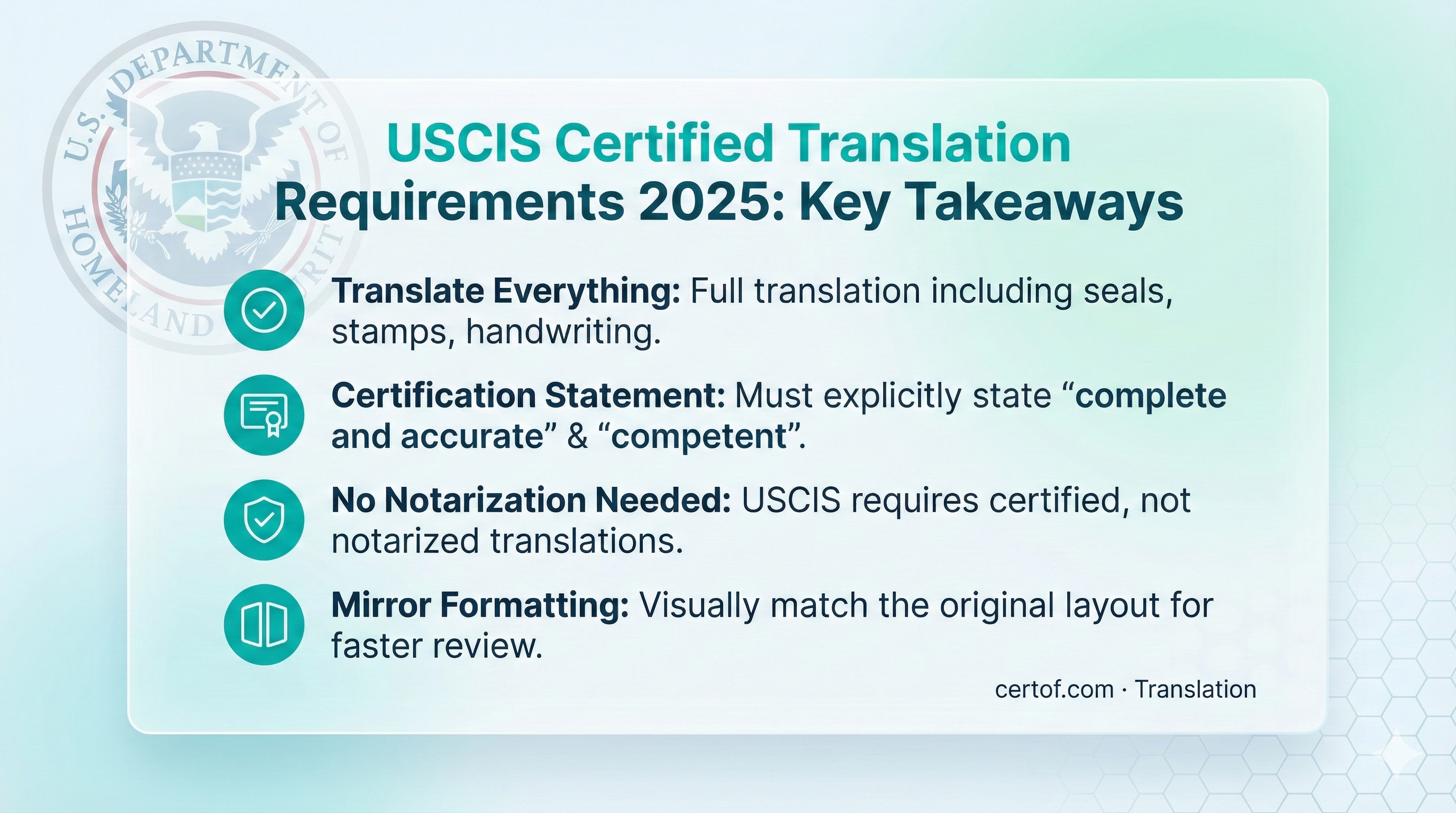
- For USCIS filings, any foreign-language document must include a full English translation with translator certification under 8 CFR 103.2(b)(3).
- The biggest problem in dependent cases is often not bad translation. It is the wrong civil-record version: a short-form birth certificate, a divorce record that does not show finality, or a missing name-change link.
- USCIS inside the United States usually works from copies plus translations, while consular processing often means bringing original civil documents and translations to the interview. That path difference matters.
- For ordinary USCIS and DOS family-document use, notarization is usually not the point. A complete certified translation is the point.
Who This Guide Is For
This guide is for families handling spouse or child dependent paperwork for an employer-sponsored U.S. work visa case anywhere in the United States. It is especially useful if you are:
- filing or extending dependent status in the United States through USCIS, often with I-539 or I-539A;
- preparing for a visa interview abroad after the principal worker already has H, L, O, TN, E, or similar employment-based status;
- working with non-English civil records such as marriage certificates, birth certificates, divorce decrees, adoption records, or name-change orders;
- dealing with common language pairs such as Chinese-English, Spanish-English, Portuguese-English, Japanese-English, Korean-English, Hindi-English, or other non-English to English document sets;
- stuck because your documents show different surnames, different spellings, prior marriages, or a child relationship that is not obvious from one record alone.
If you already understand the principal worker’s job-side immigration paperwork but are unsure how to package the family relationship records, this is the right page.
Why This Is a U.S.-Specific Guide
This topic is governed mainly by federal rules. There is no separate state translation standard for H-4, L-2, O-3, TD, or similar dependent civil documents. The real U.S.-specific differences are operational:
- USCIS filing rules and evidence expectations for the dependent packet;
- direct filing addresses and lockbox routing for paper filings;
- the Department of State reciprocity system that tells you which civil-record version is acceptable for a given country;
- the split between domestic USCIS processing and consular interview practice.
That is why this page stays tightly focused on dependent civil documents, instead of repeating broad USCIS translation basics already covered in our guides to USCIS certified translation requirements, who can certify a translation for USCIS, and certified vs. notarized translation.
How the Process Usually Works
Most families follow one of two practical paths.
1. USCIS inside the United States
If the spouse or child is filing for change, extension, or dependent classification inside the country, the starting point is the official USCIS Form I-539 instructions. USCIS expects relationship evidence for the dependent category, and any non-English record must be accompanied by a complete English translation with translator certification. For paper filings, routing depends on the official I-539 direct filing addresses, which split cases among lockbox locations such as Dallas, Elgin, and Phoenix.
2. Consular processing abroad
If the spouse or child will attend a visa interview abroad, the translation question shifts from “What does USCIS need in the packet?” to “What original civil records will the post expect me to carry?” The most important reference is the Department of State’s Visa Reciprocity and Civil Documents by Country page. That page is often more important than generic translation advice, because it determines whether your birth, marriage, divorce, or adoption record is even the right version.
Which Family Records Usually Need Certified Translation
Below is the practical document map for typical derivative spouse and child cases.
| Situation | Records commonly used | What usually creates trouble |
|---|---|---|
| Spouse dependent case | Marriage certificate; principal worker’s status record; passport identity page; prior-divorce or death record if either spouse had a previous marriage | Only translating the marriage certificate while omitting prior-marriage termination proof |
| Child dependent case | Birth certificate showing parent names; sometimes parents’ marriage certificate if names or surnames do not line up clearly | Using a short-form birth certificate that does not identify both parents |
| Stepchild case | Child’s birth certificate plus the marriage record creating the step relationship | The relationship chain is incomplete even though each single document looks valid |
| Adopted child case | Adoption decree; sometimes custody or finality-related records depending on the legal history | Submitting an adoption order without the record that shows the adoption became legally final |
| Name mismatch case | Name-change order, amended civil record, or marriage-based surname record | Trying to “fix” the spelling inside the translation instead of documenting the name chain |
If you need document-specific translation formatting help, use the deeper guides for marriage certificate translation, birth certificate translation, divorce decree translation, adoption decree translation, and name-change decree translation.
What USCIS and Consular Officers Actually Care About
For dependent civil documents, four practical checks matter more than almost anything else.
- Complete translation: The translation should cover the full record, including stamps, seals, handwritten notes, back-page entries, and registration notes if they affect meaning.
- Correct document version: A perfect translation of the wrong record is still the wrong submission. This is the silent failure point in many family cases.
- Relationship chain: Officers are not just reading one certificate. They are tracing how spouse, child, stepchild, or adopted child status is proved across multiple records.
- Name continuity: The English names across the passport, civil records, status records, and application forms should make sense as a chain. A translator should translate the document, not rewrite your identity history.
The counterintuitive part is this: in real dependent cases, document version errors often matter more than translation errors. A short-form birth certificate missing parents’ names can trigger problems even if the translation itself is excellent.
Certified Translation Requirements in Plain English
USCIS uses the language of “full English translation” plus translator certification. For a beginner, that means:
- the document must be translated into English in full;
- the certification statement must confirm completeness and accuracy;
- the translator must certify competence to translate from the source language into English.
You do not need to turn this page into a study session on translation doctrine. If you want the longer USCIS explanation, use our internal guides on USCIS certified translation samples, whether an ATA-certified translator is required, and reusing a certified translation for later USCIS cases.
How to Prepare the Packet in Real Life
USCIS filing reality
For domestic USCIS filings, families often over-focus on the principal worker’s approval notice and under-focus on the dependent relationship records. The practical workflow is:
- Confirm which dependent category applies and what relationship must be proved.
- Pull the correct civil-record version first, not just any version you have at home.
- Translate every non-English civil record that will be submitted.
- Check whether the name chain requires extra support, such as a name-change order or prior-divorce decree.
- File to the correct lockbox if submitting by paper, using the USCIS filing-address page instead of guessing.
USCIS filing is operationally simple but logistically unforgiving. Sending a package to the wrong address, mixing carrier-specific addresses, or mailing originals that USCIS did not request can create unnecessary delay.
Consular reality
For overseas interviews, the file may feel similar, but the day-of-interview experience is different. The consular officer may want to see original civil records, and the reciprocity schedule may be stricter about the exact version that counts as an acceptable birth, marriage, divorce, or adoption record. If the post expects a long-form record and you bring only a summary version, the translation will not rescue the case.
Wait Time, Cost, Mailing, and Scheduling Reality
This is one area where many generic immigration articles mislead people. There is no useful nationwide “dependent translation timeline” that predicts government processing. Translation turnaround and government adjudication are separate issues.
- Mailing reality: Paper I-539 filings go through federal lockboxes, not local USCIS walk-in counters.
- Scheduling reality: Biometrics has become less of a routine friction point for many dependent categories, but if an appointment is issued, it is by notice only.
- Interview reality: Consular practice still creates a separate logistics problem because originals, translations, and document-version compliance all meet on one interview day.
- Cost reality: Translation cost depends more on the number of documents, formatting complexity, and whether you need a family packet than on the visa category label itself.
For a digital-first route, CertOf’s public pricing and workflow are on the site’s pricing page, and the live order flow starts at the translation portal. If you want a general overview of online ordering and delivery format choices before you buy, see how to upload and order certified translation online and PDF vs. Word vs. paper delivery.
Common U.S. Failure Points
- Short-form birth certificate: It proves a birth happened, but not necessarily the parent-child relationship the officer is trying to verify.
- Prior marriage not fully documented: A current marriage certificate may not be enough if either spouse had a previous marriage that must be shown as legally terminated.
- Name mismatch with no bridge record: Different surnames across passport, marriage record, birth record, and USCIS forms create avoidable doubt.
- Only translating the front page: Registration notes, seals, and reverse-side entries can matter.
- Paying for the wrong extra service: Many families spend money on notarization when what they actually need is a correct certified translation and the right civil-record version.
What User Reports Consistently Show
Across immigration community discussions on attorney-moderated forums and long-running filing boards, the same patterns repeat:
- People often say they got an RFE “because of translation,” but the deeper issue is usually that the underlying record was the wrong version.
- Prior-divorce evidence is a frequent spouse-case weak point, especially when the translated record does not clearly show the final date or legal effect of the divorce.
- Name problems often get worse when someone tries to normalize spellings inside the translation instead of documenting the legal transition from one name to another.
- Families who reused an older translation sometimes did fine, but only when the underlying civil record was still the correct version for the current filing.
That practical pattern is why this page focuses on relationship-document mapping, not just on the translation certificate itself.
Commercial Translation Providers
The ordinary case usually needs a certified translation provider, not a sworn translator, not a notary-centered service, and not a law firm. The comparison below keeps to objective, public signals.
| Provider | Public presence signal | Useful for this topic | Boundary |
|---|---|---|---|
| CertOf | Public U.S. contact page lists 2500 Wilshire Blvd., Los Angeles, CA 90057 and phone +1 (650) 468-7435 | Strong fit for digital family packets, layout-preserving certified translations, public pricing, and direct upload workflow | Translation and document preparation support; not legal representation |
| RushTranslate | Public service page lists support phone +1 (206) 672-5052 and states ATA corporate membership plus BBB rating | Relevant if you want a national online provider that explicitly markets certified translations for USCIS-type use | Good for document service; legal eligibility questions still belong with counsel |
| ImmiTranslate | ATA member directory lists company location in Owings Mills, Maryland and public phone +1 (800) 880-0595 | Relevant for immigration-focused certified translation and document-signature style outputs | Translation-focused; not a substitute for case strategy |
What matters most for a dependent family packet is not marketing language. It is whether the provider can handle multi-document relationship files, preserve structure, include a usable certification statement, and revise quickly if your lawyer or case checklist flags a missing bridge document.
Public Resources, Legal Help, and Escalation
| Resource | What it helps with | When to use it |
|---|---|---|
| USCIS forms and filing instructions | Official evidence rules, filing logic, and address routing | Before you assemble the packet and before you mail anything |
| DOS reciprocity schedule | Country-specific civil-document version checks | Before you translate a birth, marriage, divorce, or adoption record for interview use |
| DHS CIS Ombudsman | Escalation for serious case-handling problems after normal USCIS channels | When lockbox or case issues remain unresolved after you first try USCIS |
| AILA lawyer finder | Finding an immigration lawyer for stepchild, adoption, custody, or prior-marriage complexity | When the issue is legal eligibility, not just translation format |
National Data That Actually Matters Here
There is no public USCIS dataset telling families what percentage of dependent RFEs come from marriage certificates, birth certificates, or divorce records. For this topic, the most useful nationwide reference is not a chart. It is the reciprocity framework itself. In practice, that framework explains why one family’s birth certificate works and another family’s does not.
That is also why this article does not pretend there is a state-by-state trend to compare. The demand driver is national: employer-sponsored visa families regularly move across borders with non-English civil records, and the filing risk is concentrated in document version, relationship continuity, and translation completeness.
Scam Warnings and Complaint Paths
If someone promises guaranteed approval, insider USCIS access, or tells you that a work-visa dependent case automatically needs notarization because “that is what immigration wants,” treat that as a warning sign. USCIS publishes its own avoid scams guidance, and unresolved filing-handling problems can be escalated through the DHS CIS Ombudsman after you first try normal USCIS channels.
The safest default is simple: use official rules for the filing path, use the reciprocity schedule for the document version, and use a translation provider for the translation work only.
FAQ
Does my spouse need a translated marriage certificate for H-4 or L-2 status?
If the marriage certificate is not in English and you are submitting it to USCIS or using it in a consular process that requires English translation, yes. The larger question is whether you also need prior-divorce proof or a name-change bridge to make the relationship chain complete.
Will a short-form birth certificate work for a dependent child?
Sometimes the problem is not that the certificate is translated poorly. It is that the short-form version does not identify the parents clearly enough for the purpose of proving the relationship. Check the underlying record version first.
Do I need to translate the divorce decree only if I remarried?
If prior-marriage termination is part of proving that the current marriage is legally valid for the dependent case, then the divorce record often matters. In spouse cases, that can be just as important as the current marriage certificate.
Can the translator fix spelling differences between my passport and family records?
No. A translation should translate the document you have. If the legal identity chain depends on a name change, surname change after marriage, or another official bridge, document that bridge instead of silently editing the spelling in the translation.
Can I reuse an older certified translation from a previous immigration filing?
Often yes, if the underlying document is the same and still the correct version for the present filing. But reusability does not solve a version problem. A clean old translation of the wrong civil record is still the wrong submission.
Need the Translation Side Handled Cleanly?
If your main problem is the document side rather than the legal-strategy side, CertOf can help you prepare the family packet translation: marriage, birth, divorce, adoption, and name-change records, with layout-preserving certified English translations, online ordering, and fast revision handling. You can start from the upload portal, review pricing at CertOf pricing, or read more about the service on the CertOf homepage.
If your real issue is whether a stepchild qualifies, whether an adoption is final enough, or whether your prior-marriage history creates an eligibility problem, get legal advice first and use certified translation as one part of the larger submission strategy.